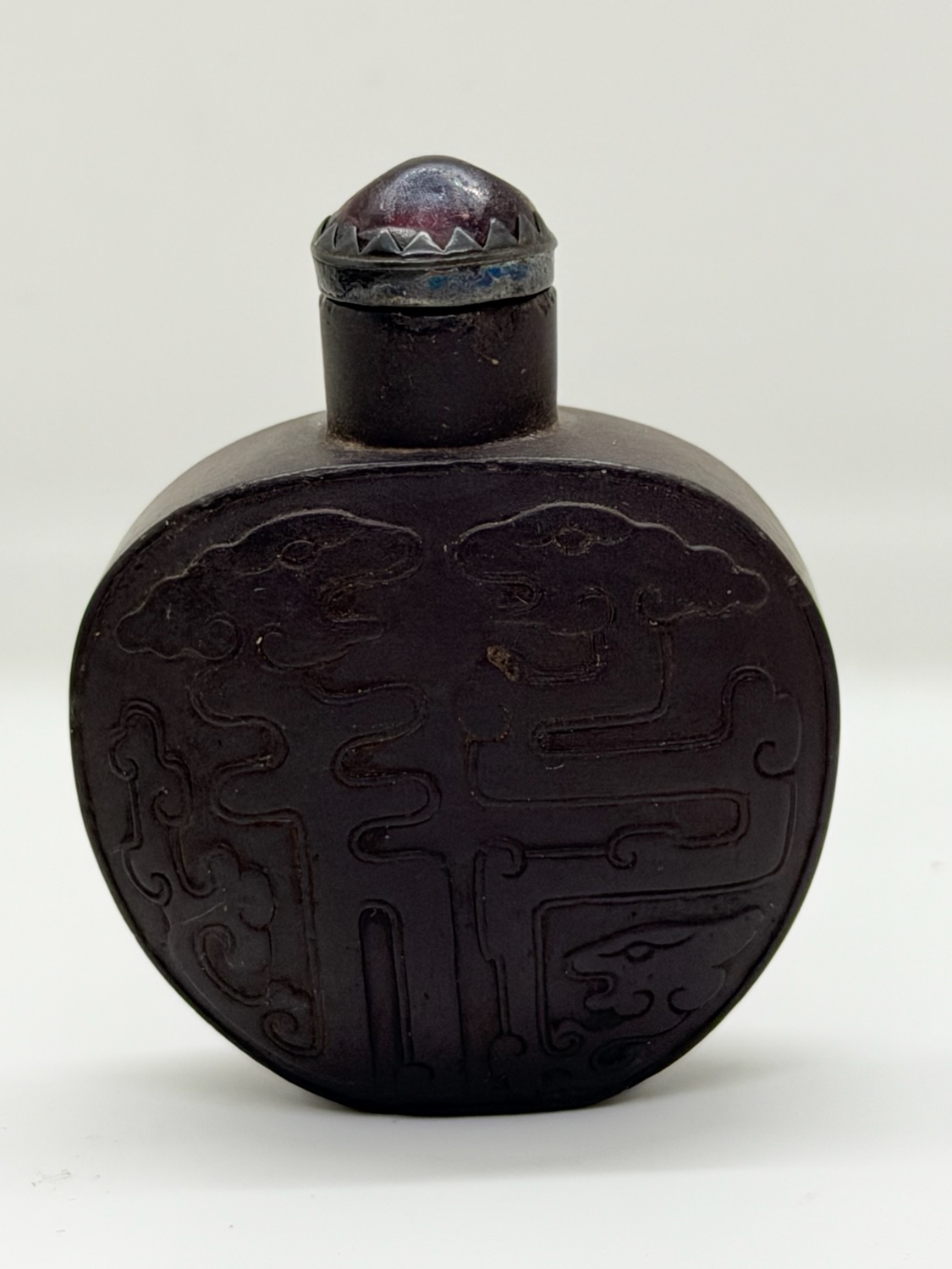
隨藏堂-鼻煙壺收藏

Suicangtang — Snuff Bottle Collection

A private collection of Chinese snuff bottles — thirty-two pieces · 私人珍藏 · 中國鼻煙壺 · 三十二件

No. 1

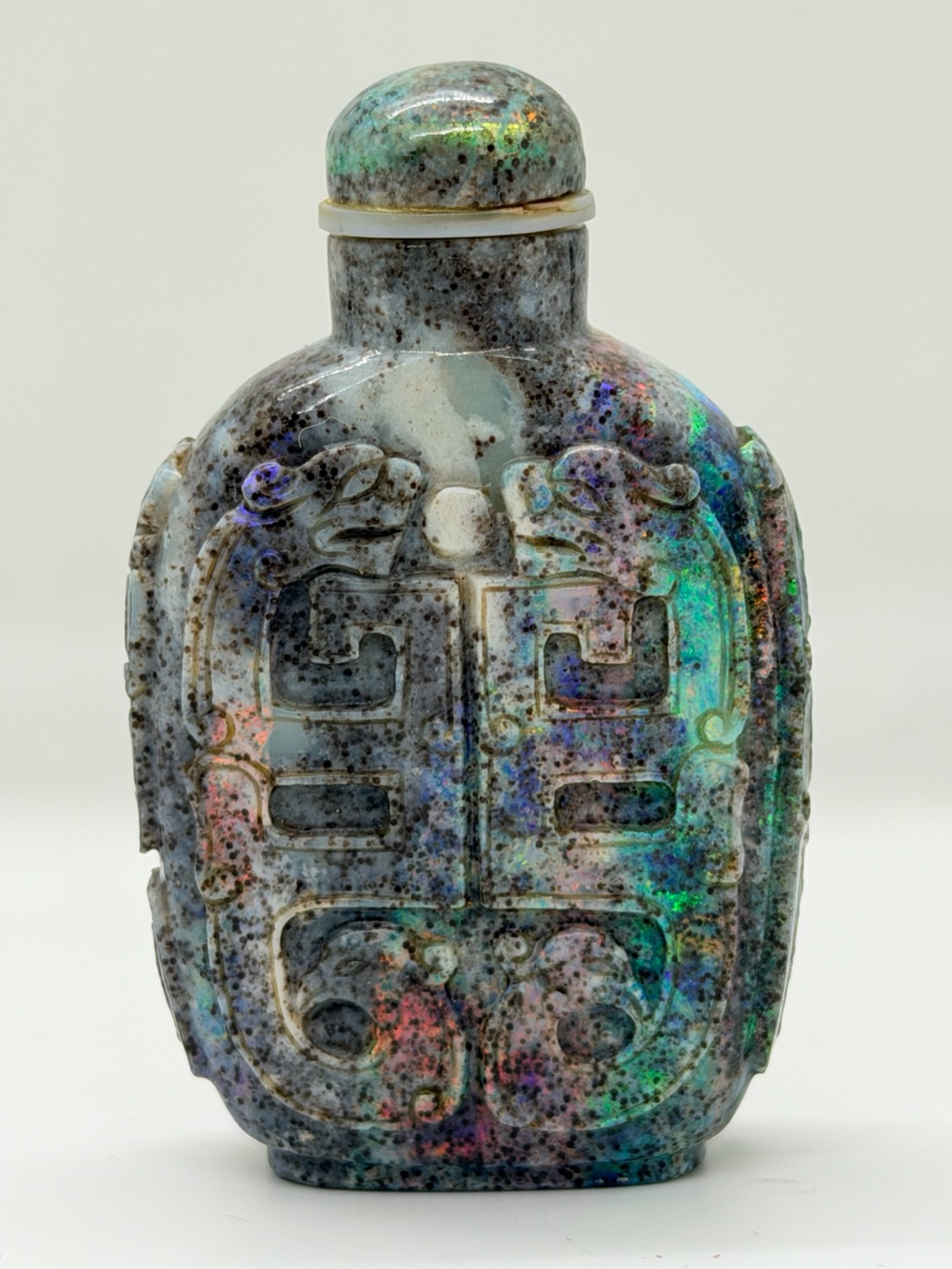
Chinese Carved Opal Snuff Bottle, Archaistic Taotie Design, Matching Opal Stopper

蛋白石雕饕餮紋鼻煙壺
Category
Stone 石質 · Opal 蛋白石
Material
Opal matrix
Period
Qing dynasty, late 19th–early 20th century
Form
Flattened rectangular, flat oval foot
Decoration
Relief-carved archaistic taotie / kui-dragon design on both faces, carved side panels
Stopper
Matching opal dome stopper with white collar
Height
2.2 in (56 mm), not including stopper
Condition
Very good condition
Notes
Good hollowing, though not exceptionally well hollowed Meaning of the carving: the taotie beast-mask and kui-dragons are archaistic motifs copied from ancient ritual bronzes — an emblem of reverence for antiquity and a protective guardian design. Tradition also reads the taotie, a famously voracious beast, as a warning against greed. The material is boulder opal — precious opal in its ironstone matrix. Queensland boulder opal was marketed in London from 1890 and commercial mining peaked around 1895 (GIA, Gems & Gemology, Spring 1993), which fixes the earliest possible date for bottles carved from it. Bonhams has catalogued a near-identical format — an upright rectangular opal bottle carved in raised relief with dragons, 2¼ in (San Francisco, 15 April 2012, lot 5745).

A Chinese snuff bottle carved from a single piece of opal matrix — boulder opal, the precious opal still locked in its ironstone host rock — of flattened rectangular form with rounded shoulders, a short straight cylindrical neck, and a flat oval foot. The stone is a mottled grey-blue densely speckled with black and dark brown matrix, with a vivid play-of-color — flashes of green, blue, violet, and red-orange fire across the surface, changing as the bottle is turned. Both principal faces are carved in relief, with some undercutting, with an archaistic design in the style of ancient bronzes: a symmetrical taotie composition built around a pair of confronted kui-dragons divided by a central vertical rib, with a round boss between the two dragon heads at the top, squared scrollwork in the middle register, and a pair of stylized beast heads at the base. As Bonhams notes of a formalised taotie design, the mask's elements double as other creatures — the horns read as simplified kui-dragons — so mask and dragon merge into one archaistic pattern. The narrow sides are also carved, each with a small archaistic dragon above panelled squared spirals (leiwen, the thunder pattern). The bottle is fitted with its matching domed opal stopper, set on a white collar. Date: Qing dynasty, late 19th to early 20th century — the Australian boulder opal the bottle is carved from only became available after opal mining began there in the late 1800s; GIA records that Queensland boulder opal was first marketed in London in 1890 and that commercial mining peaked around 1895, and carved opal bottles of this type — Case Antiques dates a comparable carved boulder opal bottle "Late 19th/Early 20th century", and Bonhams has catalogued an upright rectangular opal bottle carved in raised relief with dragons at almost exactly this height — are consistently dated to that period. The bottle is hollowed to a good standard, though not exceptionally well hollowed. The foot is a flat oval foot; the base shows the opal matrix in the rough — a speckled field flashing blue, green and pink fire.


中文說明

這件中國鼻煙壺由一整塊蛋白石(歐泊)基質雕刻而成——即礫石蛋白石,貴蛋白石仍嵌於鐵石母岩之中——呈扁平長方形,圓肩,短直圓柱形頸,平橢圓形底足。石材質地為灰藍色,密布黑色和深棕色基質斑點,表面帶有鮮豔的變彩——綠色、藍色、紫色和紅橙色的火彩交相閃爍,隨著瓶身轉動而變化。瓶身兩面均以浮雕手法雕刻仿古紋飾,局部帶剔地,取古代青銅器之風格:對稱的饕餮紋布局,由一對相向的夔龍組成,中間以一道豎棱分隔,頂部兩龍頭之間有一圓形乳釘,中部為方形卷曲紋,下部為一對獸首紋。正如邦瀚斯論一件程式化饕餮紋作品所言,獸面的各個元素本身又可作他物解讀——其角即簡化的夔龍——獸面與夔龍遂融為一體。瓶身兩側窄面亦有雕刻,各有一條仿古小龍,下方為方形雷紋。配有原配的同料蛋白石穹頂蓋,蓋下襯白色領圈。年代:清代,19世紀晚期至20世紀早期——此瓶所用的澳大利亞礫石蛋白石基質,是在19世紀晚期當地開始開採蛋白石之後才得以流通的;據美國寶石研究院(GIA)記載,昆士蘭礫石蛋白石於1890年首次在倫敦上市,商業開採約在1895年達到高峰;此類蛋白石雕刻鼻煙壺——Case Antiques曾將一件同類礫石蛋白石雕刻鼻煙壺定為「19世紀晚期至20世紀早期」,邦瀚斯亦曾著錄一件高度相近、浮雕龍紋的長方形蛋白石鼻煙壺——其年代也一貫定於這一時期。瓶身掏膛良好,但不算極佳。紋飾寓意:饕餮與夔龍為仿古紋飾,取法上古青銅禮器,象徵崇古與守護;饕餮性貪,相傳亦寓戒貪之意。底足為平削橢圓足,足面保留蛋白石基岩的天然質感,斑點間閃爍藍、綠、粉紅火彩。
No. 2

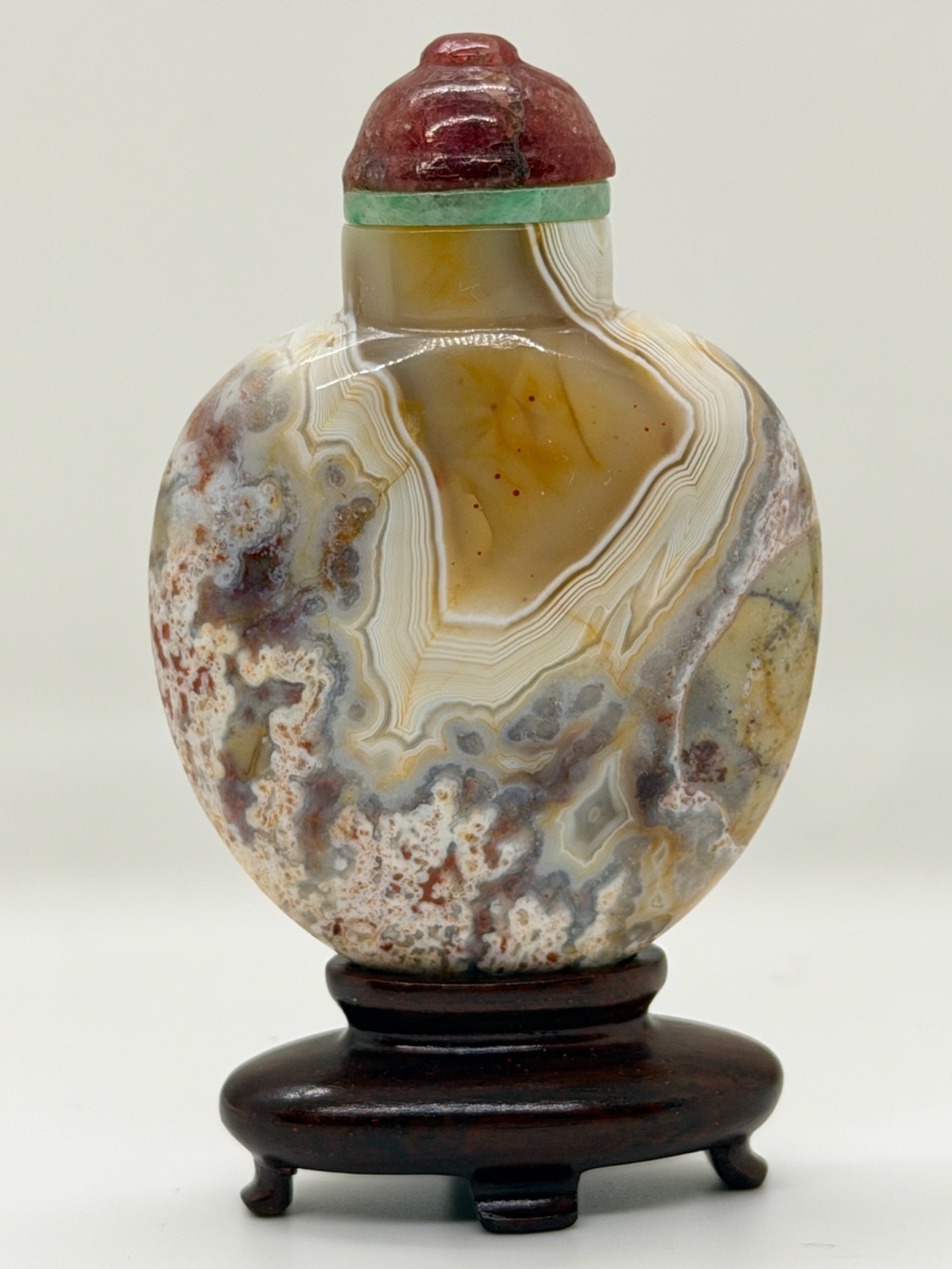
Chinese Banded Agate Snuff Bottle with Pink Tourmaline Stopper

纏絲瑪瑙鼻煙壺配粉紅碧璽蓋

Category
Agate & Chalcedony 瑪瑙 · Banded agate 纏絲瑪瑙
Material
Banded agate (chalcedony)
Period
Qing dynasty, 19th century
Form
Flattened rounded form
Decoration
Uncarved — natural banding
Stopper
Pink tourmaline dome stopper with green jadeite collar
Height
1.9 in (48 mm), not including stopper
Condition
Good condition
Notes
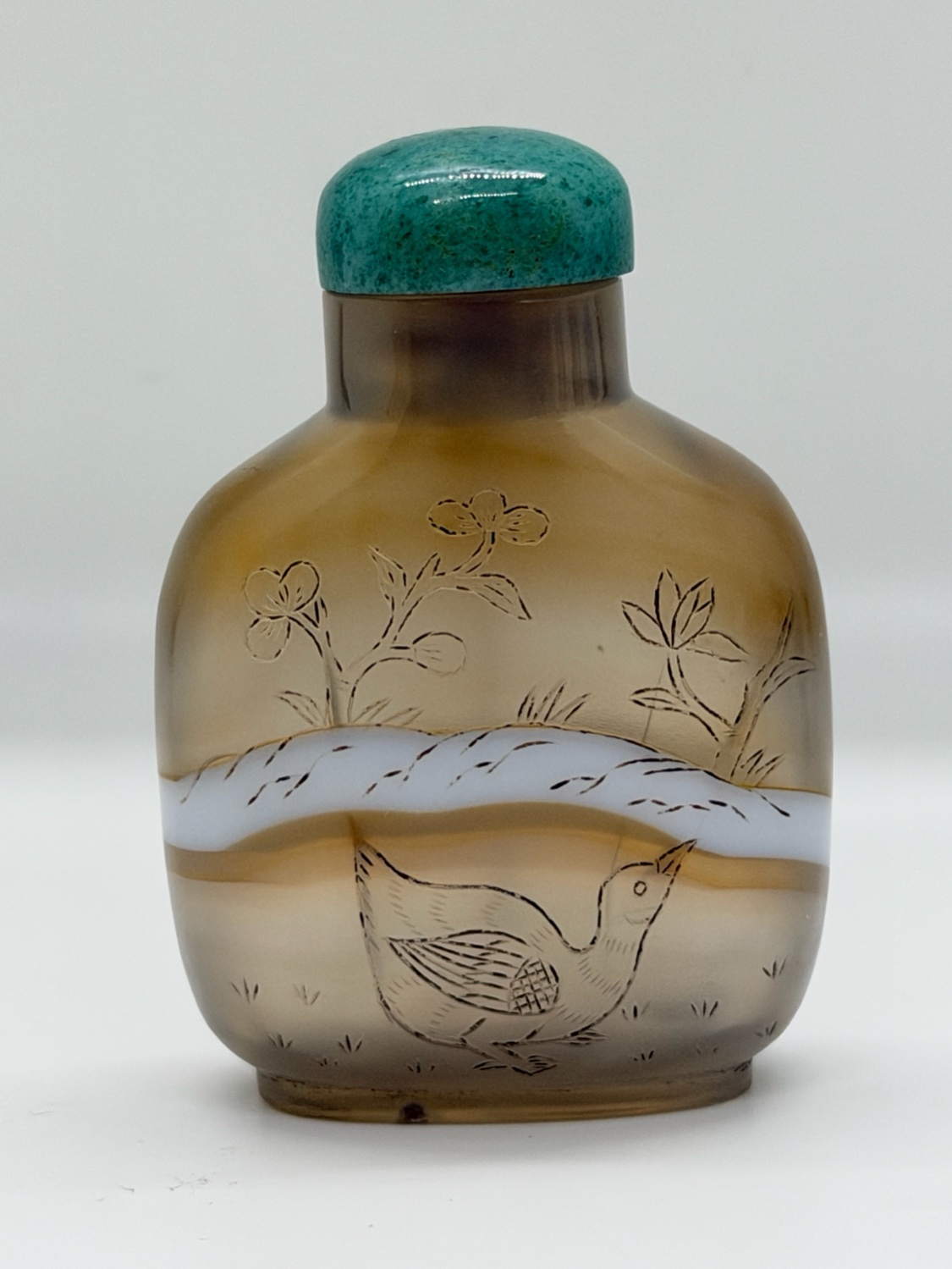
Good hollowing Meaning: this bottle is uncarved — its decoration is the stone itself. The natural bands, wound like silk threads, and the honey-amber 'window' form the picture. Agate has long been prized as a protective stone, counted among the Seven Treasures of Buddhism, and an uncarved bottle lets the material speak: the pleasure lies in reading the stone's own landscape. Bonhams notes that Qing banded agate bottles with a band around the middle were designed to resemble the jade belt of a high-rank court official — an auspicious wish for advancement. The tourmaline stopper with jadeite collar is a documented period pairing for agate bottles (Sotheby's, Hong Kong, lot 118; Metropolitan Museum of Art 21.175.158a, b).

A Chinese snuff bottle of banded agate, of flattened rounded form with a short cylindrical neck, left entirely uncarved so that the natural patterning of the stone is the decoration. The chalcedony is banded in fine concentric layers of cream, white, honey and grey — the "silk-thread" banding (纏絲) prized in Chinese agate, catalogued by the auction houses simply as banded agate with concentric striations — with mossy patches of rust-red and brown. On one face the bands centre on the surface and frame a large translucent honey-amber panel like a window, exactly the effect Christie's praises in a J & J Collection agate bottle, its "concentric bands of white and honey-colored striations centering either face against the pale misty grey body"; on the other they swirl and fold across the surface in wave-like patterns. Bonhams notes that banded agate bottles were particularly popular in the Qing dynasty when a band was positioned around the middle of the bottle, designed to resemble the jade belt worn by high-rank court officials and so forming an auspicious wish for higher office. The bottle is fitted with a deep pink tourmaline dome stopper on a bright green jadeite collar — a classic pairing for agate bottles, catalogued by Sotheby's in a single phrase, "the tourmaline stopper with a jadeite collar", and seen on a Qianlong-period agate bottle in the Metropolitan Museum of Art. Date: Qing dynasty, 19th century — plain banded agate bottles of this form were made throughout the Qing period, and the form, polish and stopper are consistent with a 19th-century date. The bottle is in good condition and hollowed to a good standard. The foot is a flat oval foot, the agate's honey and cream banding sweeping across the base.


中文說明

這件中國鼻煙壺為纏絲瑪瑙質地,呈扁圓體,短直圓柱形頸,通體不加雕刻,以石材本身的天然紋理為飾。瑪瑙呈細密的同心層狀條紋,乳白、蜜黃、灰色相間,即中國瑪瑙中備受推崇的「纏絲」紋理(拍賣行一般著錄為同心條紋纏絲瑪瑙),並帶有鏽紅與褐色的苔蘚狀斑塊。一面紋理以瓶面中心環抱著一大片半透明的蜜黃色區域,宛如一扇窗——正如佳士得著錄J & J收藏一件瑪瑙鼻煙壺所言,「白色與蜜色同心條紋居於兩面中央,襯以淡霧灰色壺身」;另一面條紋則如波浪般在表面回旋折疊。邦瀚斯指出,纏絲瑪瑙鼻煙壺在清代尤受歡迎,尤以紋帶環繞壺身中部者為然,其式仿高級官員所束玉帶,寓步步高升之願。配深粉色碧璽穹頂蓋,襯鮮綠色翡翠領圈,是瑪瑙鼻煙壺的經典搭配——蘇富比即以「碧璽蓋配翡翠領圈」一語著錄同類配蓋,大都會藝術博物館亦藏有乾隆時期瑪瑙鼻煙壺配粉紅碧璽蓋之例。年代:清代,19世紀——此類素面纏絲瑪瑙鼻煙壺在清代一直有製作,其造型、拋光與蓋的搭配均符合19世紀的特徵。品相良好,掏膛良好。寓意:此壺不施雕刻,裝飾全在石材本身。天然纏繞如絲的紋理與蜜糖色「窗」自成圖畫。瑪瑙自古被視為護身之石,列佛教七寶之一;素面無紋,正讓材質自己說話,賞石如讀畫。底足為平削橢圓足,蜜糖色與乳白色瑪瑙紋理橫貫足面。

No. 3

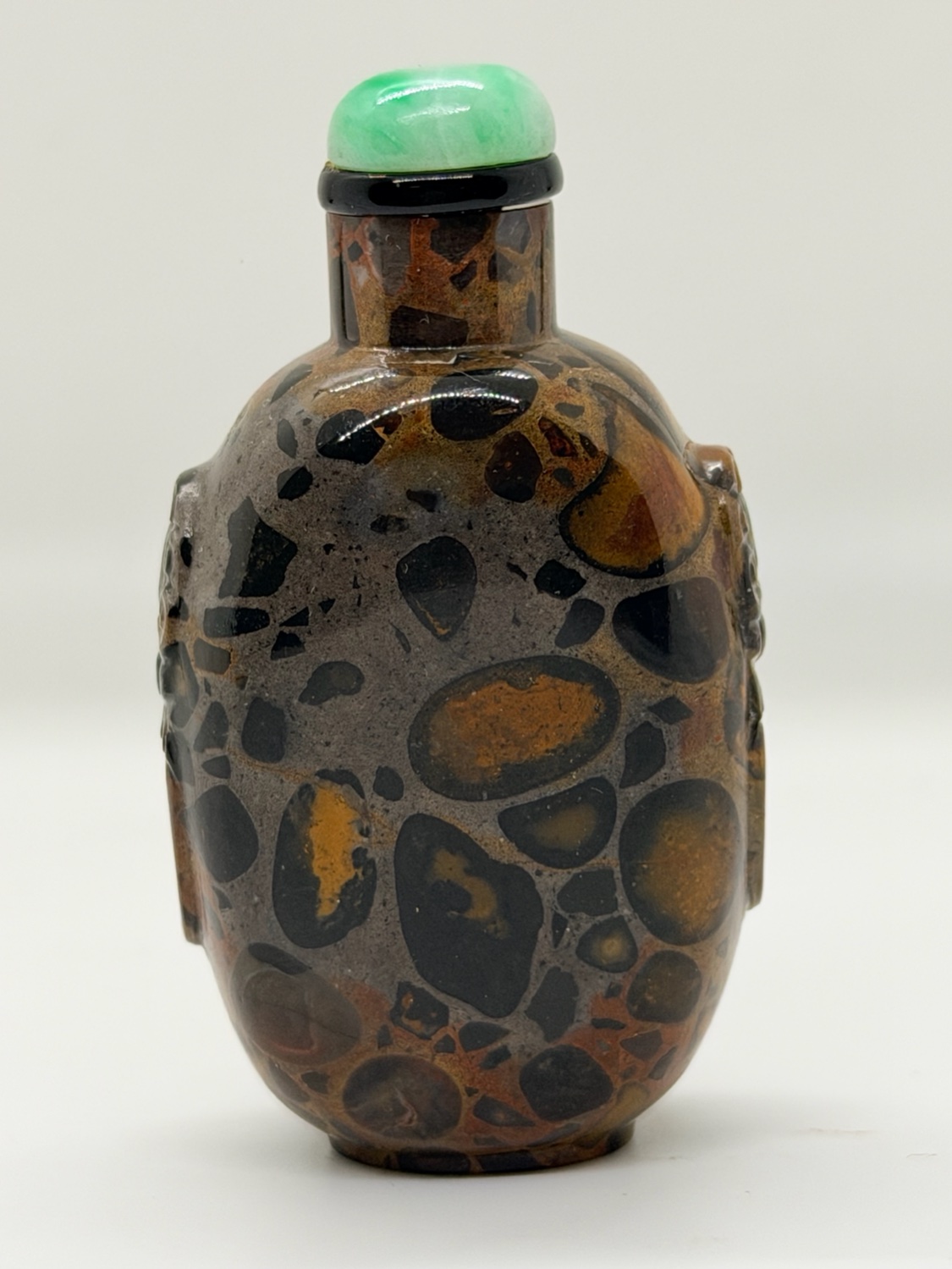
Chinese Puddingstone Snuff Bottle with Jadeite Stopper, Mask-and-Ring Handles

礫岩獸面銜環耳鼻煙壺配翡翠蓋

Category
Stone 石質 · Puddingstone 礫岩
Material
Puddingstone (conglomerate)
Period
Qing dynasty, 19th century
Form
Flattened ovoid form, oval foot
Decoration
Mask-and-ring handles carved on the narrow sides; faces uncarved, the natural pebble pattern as decoration
Stopper
Apple-green jadeite dome stopper with black collar
Height
2.1 in (53 mm), not including stopper
Condition
Good overall, with some cracks
Notes
Good hollowing Meaning of the carving: the mask-and-ring handles copy the pushou (鋪首) door-knockers of ancient bronzes — the beast mask guards the entrance and wards off evil, its loose ring hanging free. The stone itself needs no carving: its pattern is nature's own, a riverbed of coloured pebbles locked into one stone. Puddingstone (抱子石) is a quartz conglomerate; Bonhams notes the sandy ground places a bottle in the quartz (not limestone) conglomerate group, and that the stone was imported into China in the Qing dynasty. Closest parallels: Bonhams, Dorf Collection, 21 March 2023, lot 315 (mask-and-ring handles); Christie's, J & J Collection, no. 73 (compressed ovoid, 2⅛ in, jadeite stopper). The Philadelphia Museum of Art describes mask-and-ring handles as talismanic symbols originating in ancient China to ward off evil.

A Chinese snuff bottle of puddingstone — a natural conglomerate in which water-worn pebbles are locked in a hard siliceous matrix; in Chinese the stone is called baozishi (抱子石), and its sandy ground identifies it, in Bonhams' words, as belonging to "the quartz conglomerate group as opposed to the limestone conglomerate group" — of flattened ovoid form with a straight cylindrical neck and an oval foot. Large rounded pebbles of black, chestnut brown and amber lie embedded in a sandy grey-brown matrix, giving the surface the look of a riverbed seen through clear water; no two faces are alike. Bonhams defines the material as "a quartz conglomerate consisting of irregular rounded pebbles of quartz embedded in a siliceous matrix", and notes that puddingstone appears to have been imported into China in the Qing dynasty, not being found in works of art or snuff bottles before that period. The narrow sides are carved with mask-and-ring handles, the ring carved in the round below a beast mask — the same feature Bonhams catalogues on a Dorf Collection puddingstone bottle as "faux lion mask-and-ring handles". The bottle is fitted with an apple-green jadeite dome stopper on a black collar, the bright green a striking contrast to the dark earthy stone; Christie's J & J Collection puddingstone bottle — compressed ovoid form, 2⅛ in, all but identical in size — likewise carries a jadeite stopper. Date: Qing dynasty, 19th century — puddingstone bottles were made throughout the 1800s, and the form and mask handles are consistent with that date. The bottle is hollowed to a good standard; there are some cracks in the stone. The foot is a shallow recessed oval foot, polished smooth, the pebble pattern of the stone continuing across the base.


中文說明

這件中國鼻煙壺為礫岩(中文稱「抱子石」,俗稱「puddingstone」布丁石)質地——天然礫石經硅質基質膠結而成——呈扁卵形,直圓柱形頸,橢圓形圈足。邦瀚斯指出,此類沙色基質屬石英礫岩一組,有別於石灰岩礫岩。大顆圓潤的黑色、栗褐色與琥珀色卵石嵌於沙灰褐色基質之中,表面宛如隔著清水看河床石子,兩面紋理各不相同。邦瀚斯對此石的定義為「由不規則圓形石英卵石嵌於硅質基質而成的石英礫岩」,並指出礫岩應於清代方輸入中國,清代以前未見以之製作工藝品或鼻煙壺。兩側窄邊雕獸面銜環鋪首,與邦瀚斯著錄Dorf收藏一件礫岩鼻煙壺的獸面銜環耳正相吻合。配蘋果綠翡翠穹頂蓋,襯黑色領圈,鮮亮的綠色與深沉的大地色石身形成鮮明對比;佳士得J & J收藏的一件礫岩鼻煙壺,扁卵形、高2⅛吋,尺寸幾乎相同,亦配翡翠蓋。年代:清代,19世紀——此類礫岩鼻煙壺在19世紀一直有製作,其造型與獸面環耳均符合該時期的特徵。掏膛良好;石身有幾處裂紋。紋飾寓意:獸面銜環耳仿古代青銅器之鋪首,獸面守門辟邪,活環垂於口下。壺身不假雕琢,礫石天然成紋,如河床卵石凝結一體,自成圖畫。底足為淺挖橢圓足,拋光平滑,礫石紋理延續至足面。

No. 4

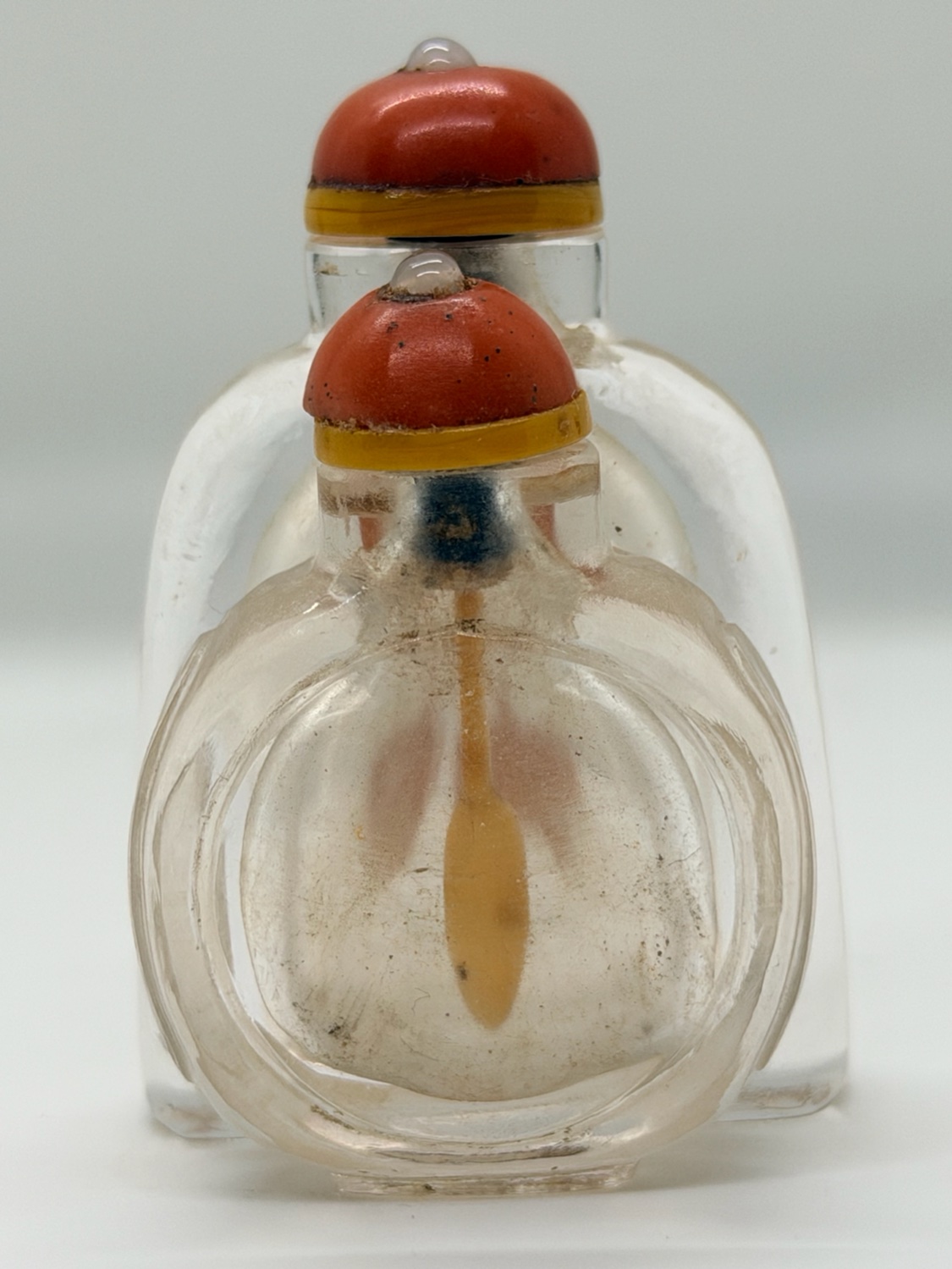
Chinese Rock Crystal Conjoined Double Snuff Bottle with Coral Stoppers

水晶連體雙鼻煙壺配珊瑚蓋

Category
Crystal & Quartz 水晶 · Rock crystal 水晶
Material
Rock crystal (clear quartz)
Period
Qing dynasty, 18th–19th century
Form
Conjoined double bottle — a tapered rectangular bottle joined to a smaller flattened circular bottle, carved from a single block
Decoration
Smaller bottle with a raised oval panel framed by concentric molding on each face; larger bottle plain
Stopper
Matching coral-red dome stoppers with yellow collars and small crystal cabochon finials; original spoons
Height
1.6 in (41 mm), not including stopper
Condition
Good condition
Notes
Good hollowing (both chambers) Meaning of the form: rock crystal stands for purity and clarity — a vessel with nothing to hide. The conjoined form, two bottles carved from a single block of stone, speaks of pairing and union: good things come in pairs (成雙成對), and the carver's skill is proved by hollowing two separate chambers from one block without breaking the wall between them. The smaller-before-larger arrangement matches the published Barron Collection double bottle (Christie's New York, 16 September 2015, lot 267; re-sold Bonhams New York, 19 March 2024, lot 465, US$3,200). Christie's notes of a double bottle that the double form may denote a harmonious marriage. Published doubles: Moss, Graham & Tsang, A Treasury of Chinese Snuff Bottles, vol. 2, nos. 249–252.

A Chinese conjoined double snuff bottle of rock crystal, carved from a single block of clear quartz as two bottles joined side by side, each with its own neck, stopper and interior chamber. The larger bottle is of tapered rectangular, spade-like form with thick polished walls; the smaller, set in front of it, is of flattened circular form, each face with a raised oval panel framed by concentric molding. The arrangement — the smaller bottle standing before the larger — is the defining feature of a celebrated published example: Christie's describes the Barron Collection rock crystal double bottle (1750–1870) as "carved as two snuff bottles conjoined in a way that one appears in front of the other". Both bottles here are fitted with matching coral-red dome stoppers on yellow collars, topped with small crystal cabochon finials, and both retain their long spoons. Conjoined bottles were a lapidary's tour de force — two separate bottles hollowed independently out of one piece of stone without breaking through into each other; Sotheby's, cataloguing a Bloch Collection crystal double bottle of the 18th/19th century, stresses chambers "very well hollowed into each separate vessel", and published doubles are gathered in Moss, Graham & Tsang, A Treasury of Chinese Snuff Bottles: The Mary and George Bloch Collection, vol. 2, nos. 249–252. At 1.6 in this example is unusually small even among doubles — the Barron bottle stands 2⅛ in. Date: Qing dynasty, 18th–19th century. Both bottles are in good condition and hollowed to a good standard. The pair stands on a thick, flat rectangular crystal base, its underside cut flat and polished.


中文說明

這件中國連體雙連鼻煙壺為水晶質地,由一整塊透明石英雕成,兩只壺並排相連,各有獨立的頸、蓋與內膛。大壺呈上窄下寬的方形鍬形,壁厚而拋光潤亮;小壺位於前方,作扁圓形,兩面各有一圈同心線框出的橢圓形凸面。小壺居前、大壺在後的布局,正是名品著錄的特徵:佳士得著錄Barron收藏一件水晶雙連鼻煙壺(1750–1870年)即謂「兩壺相連,一在前、一在後」。兩壺配成對的珊瑚紅穹頂蓋,襯黃色領圈,蓋頂各嵌一顆小水晶圓頂,兩支長煙匙俱全。連體壺是玉匠的炫技之作——在一塊石料上分別掏出兩個互不相通的內膛;蘇富比著錄Bloch收藏一件18至19世紀水晶雙連壺,亦強調其「兩個器皿各自掏膛精良」,此類雙連壺並見於《A Treasury of Chinese Snuff Bottles》第二卷第249至252號。此壺高僅1.6吋,在雙連壺中亦屬罕見的小巧——Barron藏例高2⅛吋。年代:清代,18至19世紀。兩壺品相良好,掏膛良好。器形寓意:水晶象徵純淨通透,坦蕩無隱。連體雙壺由一整塊水晶雕成,寓意成雙成對、好事成雙;佳士得論一件雙連水晶壺時亦指出,其雙連之形或寓和諧婚姻之意。一石掏出兩個獨立內膛而隔牆不破,最見匠人功力。底部為厚實的長方形水晶底座,底面平削並拋光。

No. 5

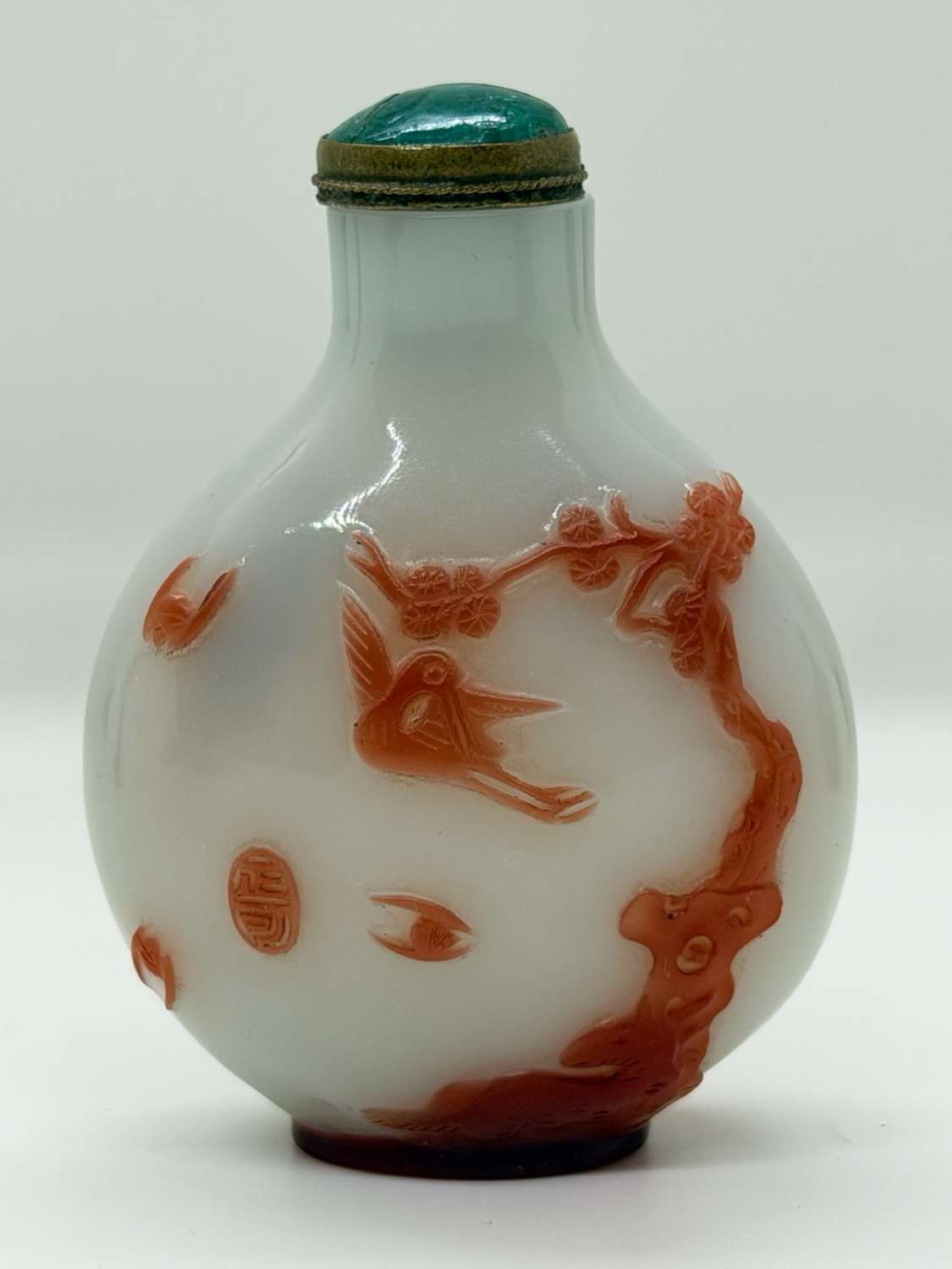
Chinese Red-Overlay White Glass Snuff Bottle with Birds, Pine and Prunus

紅套白地玻璃松梅鳥紋鼻煙壺

Category
Glass 玻璃 · Overlay glass 套玻璃
Material
Overlay glass — red overlay on an opaque milky-white ground
Period
Qing dynasty, 19th century
Form
Flattened globular form, oval foot
Decoration
Carved through the red overlay: front — a bird in flight beneath a pine branch, with an oval seal cartouche and scattered petal sprigs; reverse — birds in flight and perched among prunus branches rising from rockwork; an oval seal-script seal on the front, reading 正可 (in seal script), and a four-character seal-script inscription low on the reverse, apparently a dated mark, 辛巳年製 (1881)
Stopper
Green glass dome stopper with gilt-metal collar
Height
2.2 in (56 mm), not including stopper
Condition
Good condition
Notes
Well hollowed Meaning of the carving: pine (松) signifies longevity and steadfastness; prunus blossom (梅) signifies endurance and renewal, blooming in winter before spring. Together — two of the Three Friends of Winter — pine and plum form the wish 松梅延齡, 'may pine and plum prolong your years'; the birds among the blossom bring the vitality and joy of spring. Yangzhou-school context (Sotheby's): the group is identified by a thin layer of glass carved over a milk-white ground in low, painterly relief; about a third bear inscriptions, sometimes with a seal. Zhengke-sealed parallels: Christie's, Barron Collection Parts II and III; a Bonhams Yangzhou bottle dated autumn 1852 with Zhengke seal. Dated Yangzhou bottles cluster in 1877–1882 (Li-family bottles; a Christie's example dated 1882), supporting the 1881 date.

A Chinese snuff bottle of red overlay glass on an opaque milky-white ground, of flattened globular form with a straight cylindrical neck and an oval foot, the red overlay wrapping the footrim. The decoration is carved through the red layer to the white ground beneath, in the low, painterly relief of the Yangzhou school — Sotheby's defines the Yangzhou group by exactly this technique, "a thin layer of single or multi-colored glass carved over a milk-white ground", and notes that about a third of the group bear inscriptions, sometimes with a seal. On the front, a bird in flight passes beneath a pine branch, with an oval seal cartouche and scattered petal sprigs carved in low relief nearby. On the reverse, birds in flight and perched among blossoming prunus branches rise from pierced rockwork at the base — magpies and prunus being a documented Yangzhou subject on red overlay white glass. The bottle is fitted with a green glass dome stopper on a gilt-metal collar. Overlay glass bottles of this type were made in the 19th century, in the Qing dynasty. The front carries an oval seal reading 正可 (Zhengke) in seal script, and a four-character seal-script inscription low on the reverse reads 辛巳年製 — 'made in the xin-si year', 1881. The bottle is in good condition and is well hollowed. The Zhengke (正可) seal is a known mark on Yangzhou-school overlay glass bottles of the 19th century — a phrase seal meaning 'just right', rather than the name of an individual carver: Christie's catalogues Barron Collection Yangzhou bottles "carved with a seal reading zhengke ('just right')", in one case "an oval cartouche above the foot reading zheng ke in red glass overlay", and Bonhams records a Yangzhou bottle dated to the autumn of 1852 with a carved Zhengke seal. Dated Yangzhou bottles cluster late — Christie's has offered a Yangzhou overlay bottle dated 1882, and the Li-family Yangzhou bottles carry dates from 1877 to 1881 — so the 1881 date of this bottle sits squarely within the dated group. The foot is a concave oval foot, its rim wrapped in the red overlay, the white glass recessed within.


中文說明

這件中國鼻煙壺為套玻璃質地——乳白色地上套紅色料——呈扁球形,直圓柱形頸,橢圓形圈足,紅色套料包至足邊。紋飾以套料雕刻手法琢出,剔紅露白,浮雕低平而富畫意,正是揚州派的作風——蘇富比對揚州派套玻璃的界定正是「在乳白地上琢刻一層薄薄的單色或多色玻璃」,並指出該組作品約有三分之一帶有題款,有時並鈐印章。正面雕一隻飛鳥掠過松枝之下,旁有橢圓形印章式紋章及散點花瓣紋。背面雕群鳥或飛或棲於梅枝之間,枝幹自底部嶙峋洞石間生出——喜鵲與梅花正是揚州派紅套白地玻璃有著錄的主題。配綠色玻璃穹頂蓋,襯鎏金屬領圈。此類套玻璃鼻煙壺盛行於清代19世紀。正面刻有橢圓形篆書印章一方,為篆書「正可」二字;背面下方刻有篆書四字「辛巳年製」(1881年)。品相良好,掏膛極佳。「正可」印為揚州派套玻璃鼻煙壺上常見的款識,是意為「恰到好處」的吉語印,並非匠人姓名:佳士得著錄Barron收藏的揚州派作品即有「刻正可印」者,其中一方且為「足上橢圓框內以紅料刻正可二字」;邦瀚斯亦著錄一件1852年秋款、帶正可印的揚州派鼻煙壺。有紀年的揚州派作品多集中於晚期——佳士得曾拍賣一件1882年款的揚州派套玻璃壺,李氏揚州作品的紀年則在1877至1881年之間——此壺1881年之款正落在這一斷代群之中。紋飾寓意:松象徵長壽與堅貞,梅象徵堅忍與新生,寒冬綻放、迎春而來。松、梅同為「歲寒三友」之二,合稱「松梅延齡」,祝願延年益壽;花間飛鳥則帶來春日的生機與喜悅。底足為凹底橢圓足,足圈以紅色套料包邊,內凹處露白地玻璃。

No. 6

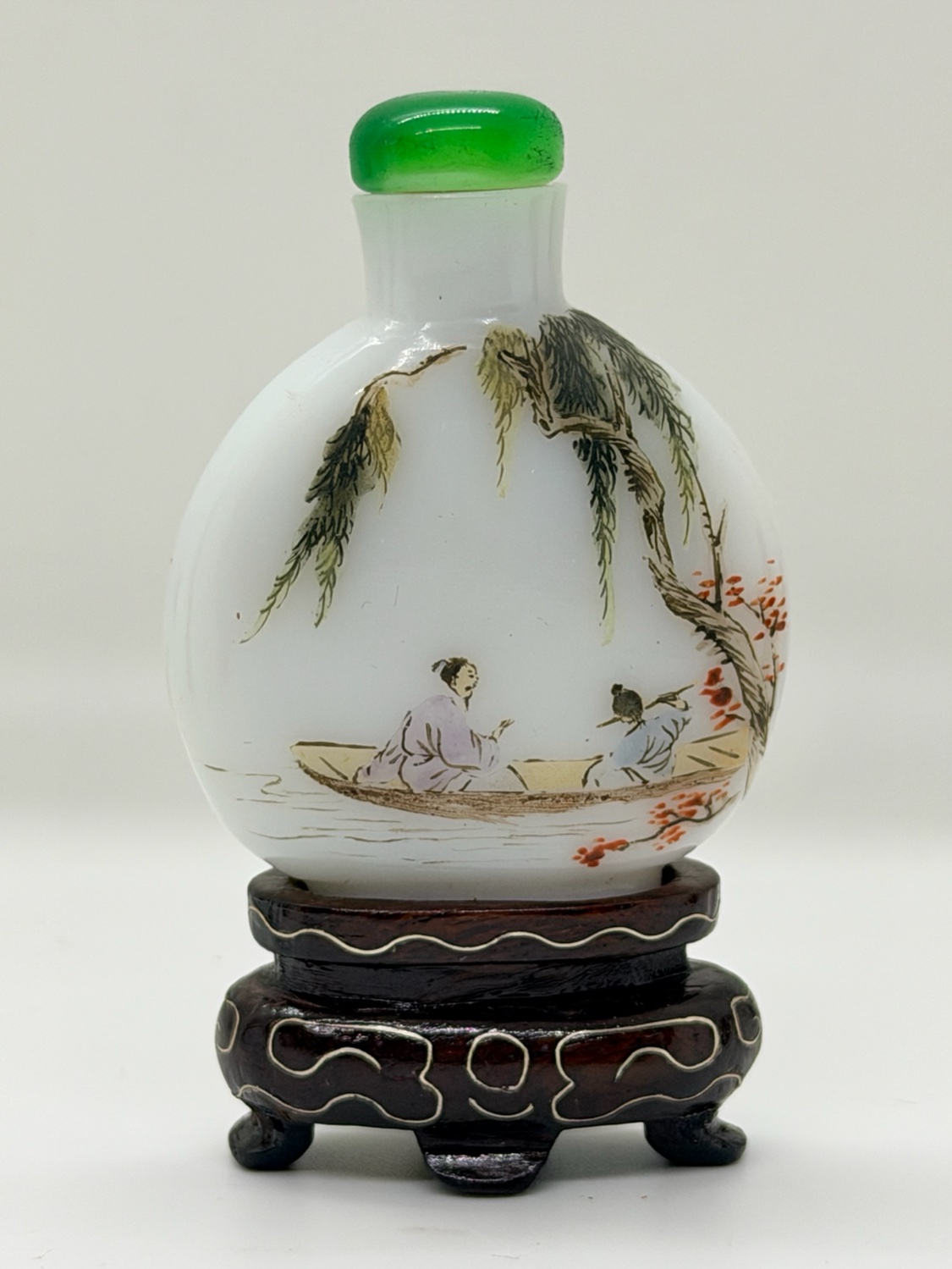
Chinese Enamelled White Glass Snuff Bottle with Figures in Landscape

玻璃胎畫琺瑯人物山水鼻煙壺

Category
Glass 玻璃 · Enamelled glass 玻璃胎畫琺瑯
Material
Enamelled glass — enamel painting on an opaque white (milk) glass body
Period
Late 19th–early 20th century
Form
Flattened circular form
Decoration
Enamel-painted scenes: front — two figures in a boat beneath a willow; reverse — an elderly man with a staff beneath a pine, a boy attendant approaching with red flowers
Stopper
Bright green glass cabochon stopper
Height
1.9 in (48 mm), not including stopper
Condition
Chipped
Notes
Good hollowing. Photographed on a wire-inlaid wooden stand (not part of the bottle). The base bears an iron-red seal-script Qianlong nianzhi (乾隆年製) mark, an apocryphal mark typical of enamelled glass. Meaning of the painting: the scenes wish the owner a long, serene life. In front, two figures drift in a boat beneath a willow — the cultivated pleasure of a spring outing; the willow (柳) also puns on 留, 'to linger', the wish that good fortune stays. Behind, an elder with his staff rests beneath a pine, the tree of longevity, while a boy brings him flowers — filial devotion, and blessings offered to old age. Market parallels: Doyle, 14 March 2016, lot 148 (19th century, Guyue Xuan mark, est. $800–$1,200) and 13 March 2017, lot 301 (Qing, figural scenes both sides, est. $1,000–$1,500). On the mark: Sotheby's (Grimberg Collection, lot 122) calls the Qianlong nianzhi mark on enamel-on-milk-glass 'apocryphal' and documents early-20th-century commercial production by Ye Bengqi sold as Palace originals; Christie's notes the genuine late-Qianlong Yangzhou group was marked in pale iron-red seal script — the form this mark imitates.

A Chinese snuff bottle of opaque white (milk) glass, painted in enamels in soft colours, of flattened circular form with a short cylindrical neck. On the front, two figures sit in a boat on the water beneath a drooping willow, with red blossom at the side. On the reverse, an elderly man holding a staff stands beneath a pine tree in a landscape, while a boy attendant approaches carrying red flowers. The two-face figural programme — a scene of figures on one side, a second scene on the other — is the standard layout of the enamelled white glass group: Doyle has catalogued 19th-century examples painted with a scholar and attendant on one face and a flower-gathering scene on the reverse, and Qing examples with figural scenes on both sides. The bottle is fitted with a bright green glass cabochon stopper. It is photographed on a wire-inlaid wooden stand, which is not part of the bottle. Enamelled glass bottles of this type were produced from the late Qing dynasty into the early 20th century. There is a chip to the bottle; it is hollowed to a good standard. The base bears an iron-red seal-script Qianlong nianzhi (乾隆年製) mark — an apocryphal mark of a type commonly found on enamelled glass. The mark's form imitates a genuine group: Christie's notes that the late-Qianlong enamelled glass bottles attributed to Yangzhou "are usually marked either with a pale Qianlong reign mark or a Guyuexuan mark in iron-red", and Sotheby's uses the same word — "apocryphal" — for the Qianlong nianzhi mark on an enamel-on-milk-glass bottle, noting that early-20th-century enamellers such as Ye Bengqi produced enamelled glass bottles commercially which dealers sold as 18th-century Palace originals. It is against that background that this bottle is dated to the late 19th–early 20th century.


中文說明

這件中國鼻煙壺為不透明白色玻璃(乳白玻璃)質地,表面以琺瑯彩繪製圖案,呈扁圓形,短直圓柱形頸。正面繪兩位人物泛舟水上,上方垂柳依依,旁有紅色花枝。背面繪一位持杖老者立於松樹之下,童子捧紅花走近,遠景為山水。兩面各繪一景的人物圖,正是玻璃胎畫琺瑯鼻煙壺的典型布局:Doyle拍賣行曾著錄19世紀同類作品,一面繪文士與侍者、一面繪採花人物,亦有清代兩面皆繪人物者。配鮮綠色玻璃圓頂蓋。此類琺瑯彩玻璃鼻煙壺多為清末至20世紀初製品。壺身有磕缺;掏膛良好。壺底有礬紅篆書「乾隆年製」款,為琺瑯彩玻璃常見的寄托款。此款式樣正是摹仿真品的一組:佳士得指出,歸於揚州的乾隆晚期玻璃胎畫琺瑯鼻煙壺「通常鈐淡礬紅乾隆款或礬紅古月軒款」;蘇富比著錄一件乳白地琺瑯彩玻璃壺時,亦以「寄托款」(apocryphal)稱其乾隆年製款,並指出20世紀初葉本畿等琺瑯匠人曾商業性製作此類鼻煙壺,經北京古董商之手冒充18世紀宮廷原作出售。此壺定為清末至20世紀初,正是本於這一背景。畫面寓意:兩面圖景同祝長壽安康。正面二人泛舟垂柳之下,是文人春日遊湖之樂;柳諧音「留」,寓好運長留。背面老者持杖立於松下,松為長壽之樹,童子捧花而至,是孝親獻瑞之景。

No. 7

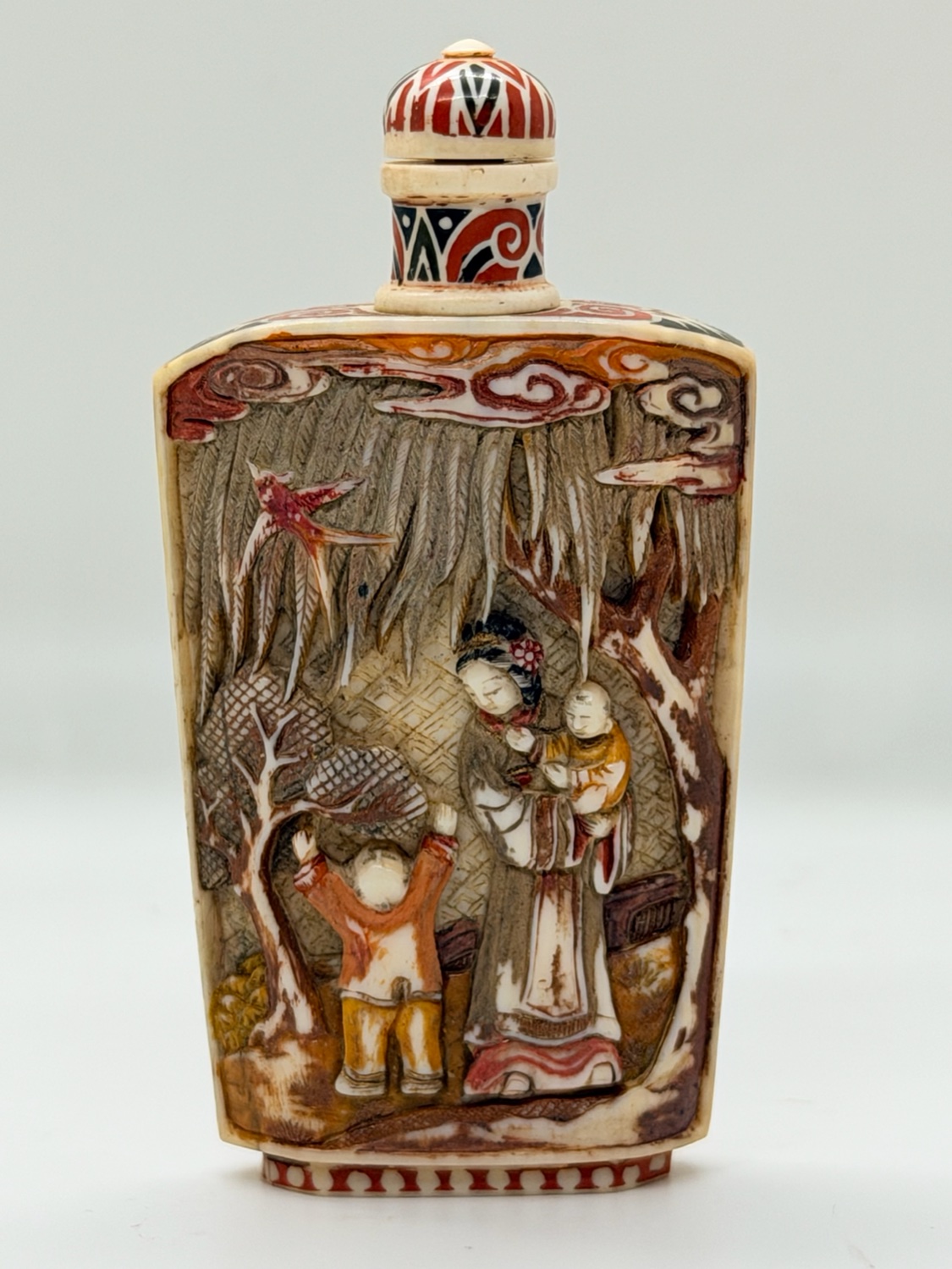
Chinese Carved and Stained Ivory Snuff Bottle with Lady and Children

牙雕彩繪仕女童子鼻煙壺

Category
Organic & Other 有機及其他 · Ivory 牙雕
Material
Carved ivory with polychrome staining
Period
Late 19th–early 20th century
Form
Flattened rectangular form tapering toward the foot
Decoration
Front relief-carved with a lady holding a child beneath a willow, a second child reaching toward a swallow, pine and cloud scrolls, the details stained in red, brown, ochre and green; reverse a black-filled panel engraved with bamboo, rocks and an inscribed poem in white, flanked by red key-fret borders; neck, shoulders and stopper with bold geometric patterns in red, black and green
Stopper
Matching carved ivory dome stopper with geometric staining
Height
2.5 in (64 mm), not including stopper
Condition
Good
Notes
The base bears a red two-character Qianlong (乾隆) seal mark (apocryphal). The reverse poem is the opening of Liu Changqing's (劉長卿) 'Tiaoxi, in Reply to Liang Geng' (苕溪酬梁耿別後見寄 / 謫仙怨), Tang dynasty; signed Xushi Ren (敘士仁), the craftsman. Parallels for the type: Doyle, 19 March 2012, lot 8 (late 19th century, 2½ in, inscription reverse, sold $469) and lot 10 (polychrome pigment painted ivory, Qianlong seal mark, late 19th century, sold $1,125); Chiswick, 20 May 2019, lot 320 (stained ivory, early 20th century, formal borders and decorated stopper). No comparable carrying the 敘士仁 signature or this Liu Changqing text was found in the auction records searched.

A Chinese snuff bottle carved from ivory and decorated with stained polychrome colour — "carved, painted and stained ivory", in the sale-room term — of flattened rectangular form tapering toward the foot, with a cylindrical neck. The front is relief-carved with a lady holding a small child beneath a willow, a second child reaching up toward a swallow, with a pine tree and cloud scrolls above, the details picked out in red, brown, ochre and green staining. The reverse is a flat panel filled in black, engraved with bamboo and rocks in white and an inscribed poem in white characters, flanked by red key-fret borders; the neck, shoulders and stopper carry bold geometric patterns in red, black and green. The two-sided scheme — a carved figural scene on one face, an inscription panel as the whole decoration of the other — is a recognised layout for this class: Doyle catalogued a late-19th-century pigment-painted ivory bottle of exactly this height (2½ in) with a landscape incised on one side and a lengthy inscription on the reverse, and Chiswick a stained ivory bottle whose formal borders at shoulder and foot and decorated stopper parallel the patterned neck, shoulders and stopper here. The base bears a red two-character Qianlong seal mark — an apocryphal homage mark: Doyle dates stained and pigment-painted ivory bottles bearing Qianlong seal marks to the late 19th century, and the mark is no evidence of a Qianlong-period date. Bottles of this stained-ivory type were produced from the late Qing dynasty into the early 20th century. The inscribed poem is the opening of the Tang-dynasty poet Liu Changqing's (c. 726–786) 'Tiaoxi, in Reply to Liang Geng' (苕溪酬梁耿別後見寄), also known as the lyric Zhixian Yuan (謫仙怨) — a farewell to a friend sent into exile. It reads: 「清川水路何極,落日孤舟解攜,鳥向平蕪遠近,人隨流水東西」 — 'The clear river runs on; where does its road end? At sunset a lone boat casts off, and we part. Birds cross the grassy plain, now far, now near; men drift with the flowing water, east and west.' It is signed Xushi Ren (敘士仁), the craftsman.


中文說明

這件中國鼻煙壺為象牙雕刻,並以染色點綴色彩(拍賣行稱之為「雕刻彩繪染色象牙」),呈扁方形,下部漸收,圓柱形頸。正面浮雕一位仕女抱著幼童立於垂柳之下,另一童子伸手仰望燕子,上方有松樹與雲紋,細節以紅、褐、赭、綠等色染色。背面為平面黑地,以白色刻畫竹石,並以白字刻一首詩詞,兩側飾紅色雷紋邊;頸部、肩部與蓋子飾紅、黑、綠色幾何圖案。一面雕人物、一面以詩文為飾的雙面布局,是此類鼻煙壺的固有格式:Doyle拍賣行曾著錄一件清末同類作品,高2½吋,與此壺相同,一面線刻山水、一面長篇題字;Chiswick亦曾著錄一件染色牙雕壺,其肩、足處的程式化邊飾與刻花蓋子,與此壺頸、肩、蓋的圖案正相呼應。壺底有紅色雙字「乾隆」印款,為寄托款——Doyle將帶乾隆印款的染色、彩繪象牙鼻煙壺定為19世紀晚期,可見此款並非乾隆本朝之證。此類染色牙雕鼻煙壺多為清末至20世紀初製品。背面詩句出自唐代劉長卿《苕溪酬梁耿別後見寄》(又作《謫仙怨》),為送別謫友之作:「清川水路何極,落日孤舟解攜,鳥向平蕪遠近,人隨流水東西」,署「敘士仁」。(版本字句略有出入,如「水路」一作「永路」,壺上所刻為已知版本之一。)

No. 8

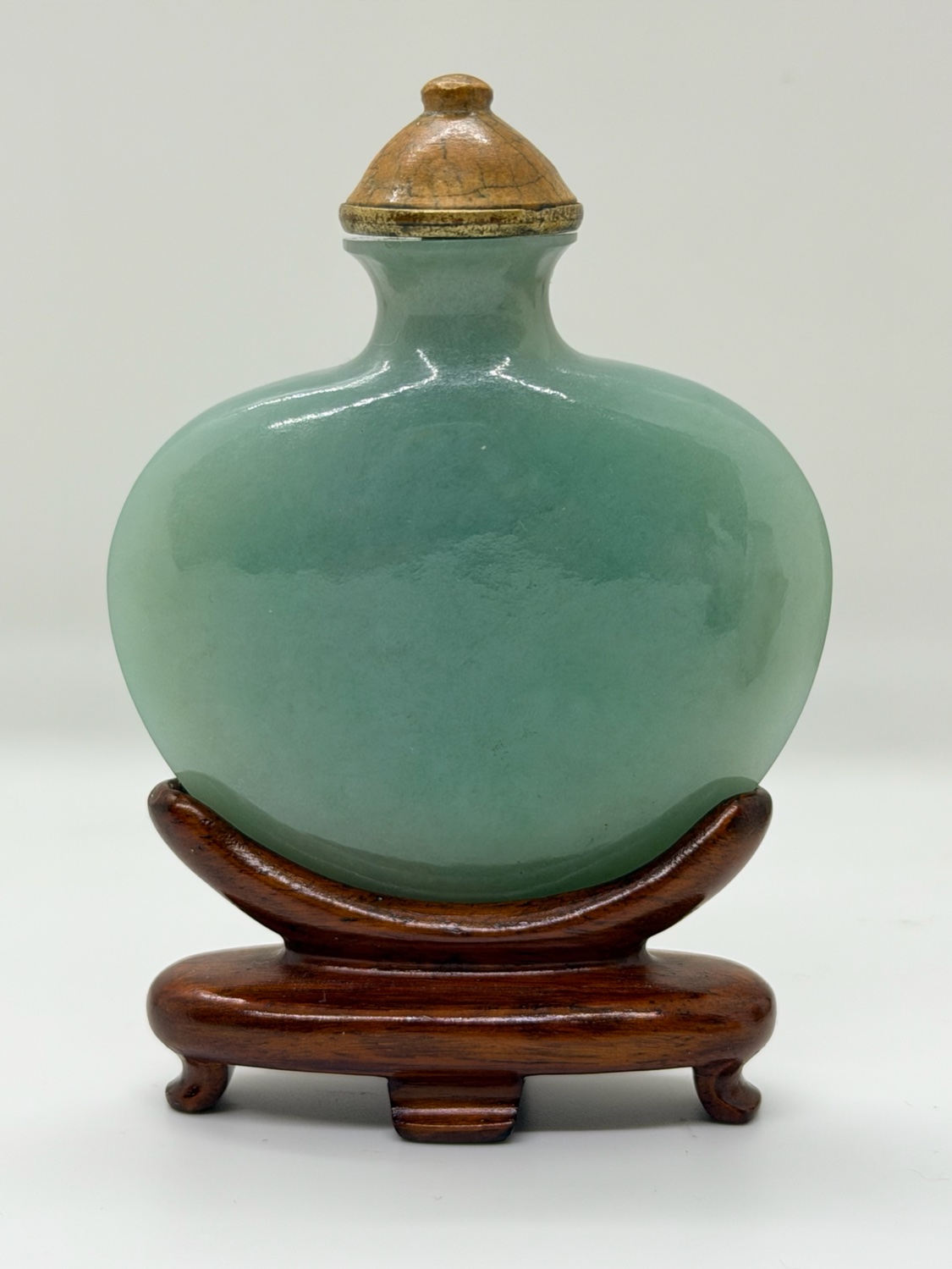
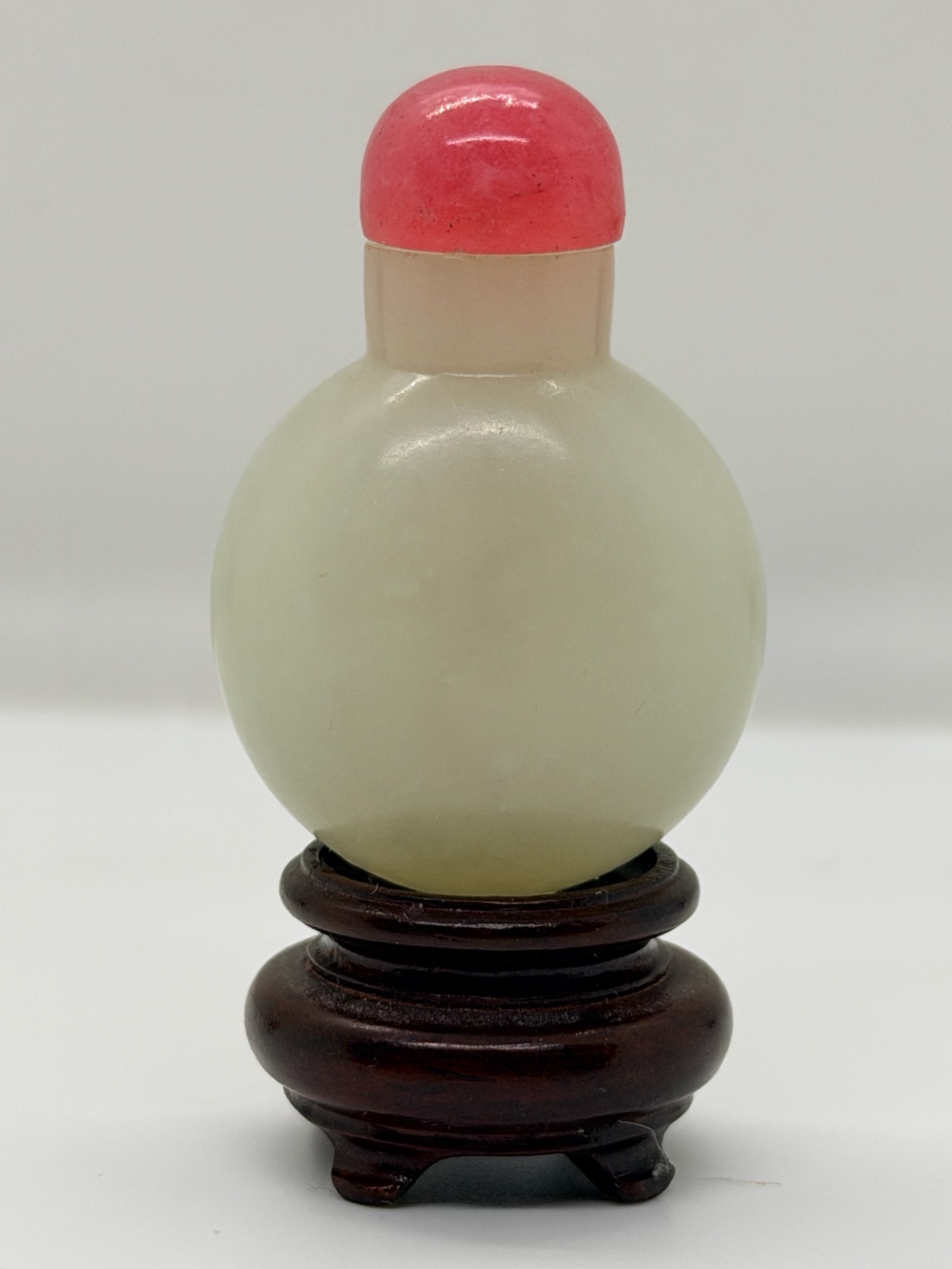
Chinese Pale Celadon-Green Jadeite Snuff Bottle

翡翠淡綠素面鼻煙壺

Category
Jade 玉石 · Jadeite 翡翠
Material
Jadeite
Period
Qing dynasty, 19th century
Form
Flattened circular (moon-flask form)
Decoration
Plain, uncarved
Stopper
Brown crackle-pattern dome stopper
Height
2.3 in (58 mm), not including stopper
Condition
Good
Notes
Good hollowing. Meaning: the bottle is uncarved — its beauty is the stone and the form. The flattened disc, round as the full moon, speaks of completeness and reunion (圓滿); jadeite itself has long stood for virtue, purity and protection, and a plain surface lets the colour and translucency of the stone speak undisturbed. Dating background (Christie's): Burmese jadeite supplies were regularised only after 1784 and jadeite bottles were made at Court from the later Qianlong reign; the best-coloured material was frequently left plain, judged by translucency and evenness of colour. Bonhams calls the plain moon-flask form in thinly cut material 'a characteristic product of the late Qing dynasty' (21 September 2021, lot 652). Published parallels: Bloch Collection, Treasury vol. 1, nos. 171–185; Barron Collection plain pale jadeite, 1800–1900, 2¼ in.

A plain snuff bottle carved from pale celadon-green jadeite, of flattened circular form — round as a full moon — with a short cylindrical neck and slightly flared lip. The stone is of an even, soft blue-green tone, gently translucent, with a smooth waxy polish; there is no carving, the material itself being the decoration. Plainness here is a deliberate choice, not an economy: Christie's, writing of jadeite bottles, notes that "the best colored specimens were frequently left plain so that no decoration diverted attention from the natural beauty of the material", and names "translucency, and a good evenness of color" as two important characteristics of good jadeite — both on show in this bottle's even tone. Sotheby's makes the same point of the type, describing "a series of often plain, compressed ovoid or spherical bottles allowing the highly-valued material to speak for itself". Jadeite itself sets the dating frame: the stone comes from Burma, and Christie's records that regular supplies reached China only after relations with Burma were normalised in 1784, with jadeite bottles regularly made for the Court in the later Qianlong reign — a 19th-century date for a plain jadeite bottle is the norm, and Bonhams, cataloguing a plain moon-flask jadeite bottle of 1850–1920, calls the simple form in thinly cut material "a characteristic product of the late Qing dynasty". Published plain jadeites of this family are gathered in the Bloch Collection, A Treasury of Chinese Snuff Bottles, vol. 1, nos. 171–185; a plain translucent pale jadeite bottle of 1800–1900 in the Barron Collection stands 2¼ in, close to this bottle's size. The stopper is a dome of brown crackle-patterned material with a small knop and a dark collar. Good hollowing. Photographed on a wooden stand, which is not part of the bottle. The bottle rests on a small flat oval foot; the back is a smooth, gently convex disc of even pale celadon-green jadeite.


中文說明

翡翠質,清代十九世紀,色淡青綠,扁圓形如滿月,短直頸,唇口微侈。通體素面無紋,色澤均勻柔和,微透光,拋光溫潤,裝飾全在石材本身。素面並非省工,而是刻意的選擇:佳士得論翡翠鼻煙壺時指出,「顏色最佳的料子往往留作素面,不加雕飾,以免分散對材質天然之美的注意」,並以「透光度」與「顏色均勻」為優質翡翠的兩大標準——此壺色調均勻,正合後者。蘇富比論同類作品亦言,當時有一系列「多為素面的扁卵形或球形鼻煙壺,讓珍貴材質自己說話」。翡翠的產地亦框定了年代:翡翠出緬甸,據佳士得記載,1784年中緬關係正常化後料石方有穩定供應,乾隆後期宮廷已常以翡翠製鼻煙壺,故素面翡翠壺以19世紀為常態;邦瀚斯著錄一件1850至1920年的素面月瓶形翡翠壺時,更直言此種簡式薄胎正是「晚清的典型製品」。此類素面翡翠壺的著錄可參Bloch收藏《A Treasury of Chinese Snuff Bottles》第一卷第171至185號;Barron收藏一件1800至1900年的素面半透淡色翡翠壺高2¼吋,與此壺相近。配褐色冰裂紋圓頂蓋,具小鈕與深色蓋托。掏膛良好。寓意:此壺素面無紋,美在石材與器形;扁圓如滿月,寓意圓滿團圓;翡翠自古象徵品德、純潔與護佑,素面正讓石色與水頭不受干擾地呈現。壺底為小橢圓平足,背面為平滑微凸的圓面,淡青綠色澤均勻。

No. 9

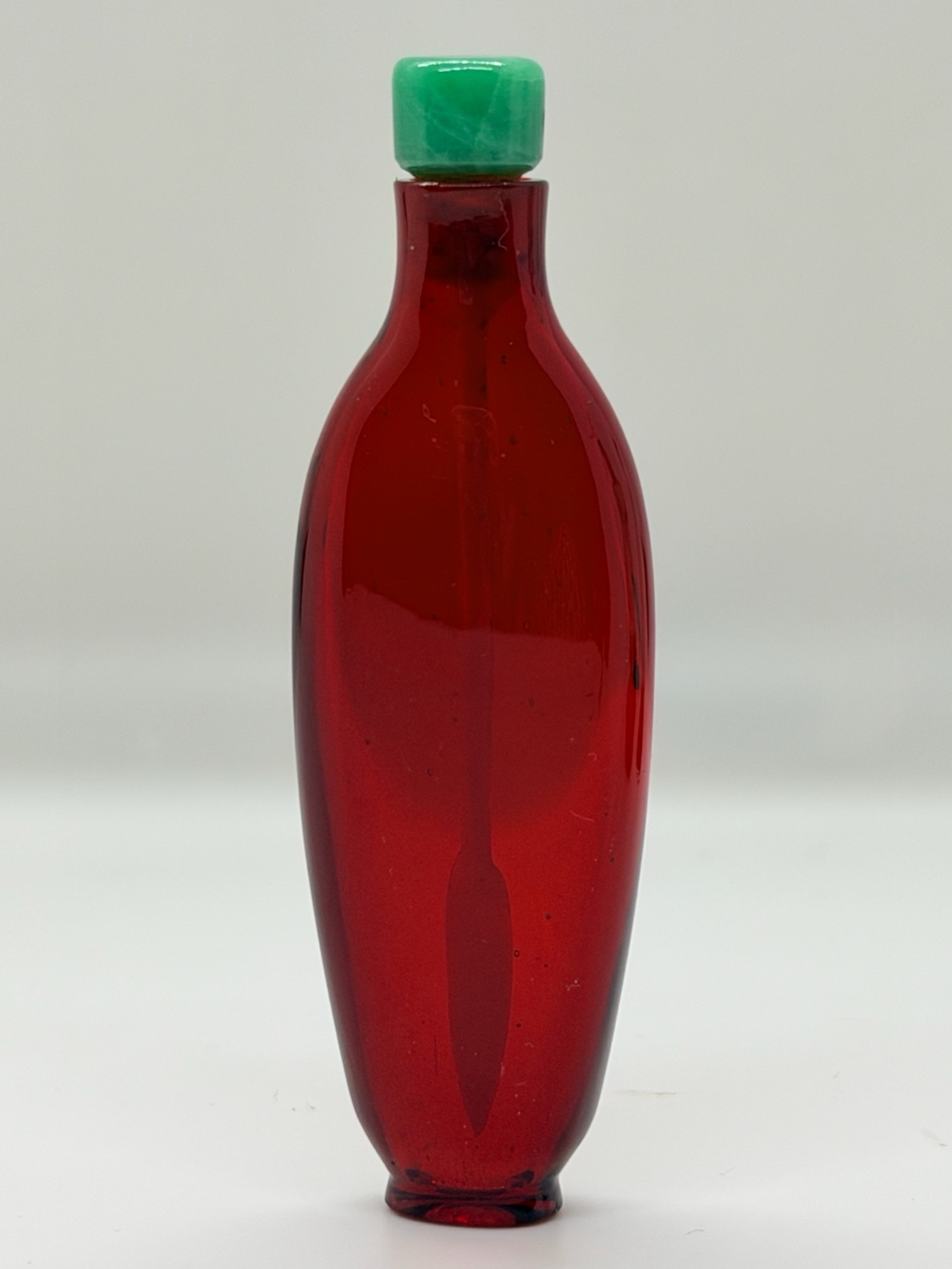
Chinese Ruby-Red Glass Snuff Bottle with Jadeite Stopper

寶石紅玻璃鼻煙壺配翡翠蓋

Category
Glass 玻璃 · Plain glass 素玻璃
Material
Ruby-red glass
Period
Qing dynasty, 19th century
Form
Elongated flattened ovoid, cylindrical neck
Decoration
Plain, transparent
Stopper
Cylindrical jadeite stopper
Height
2.7 in (69 mm), not including stopper
Condition
Good
Notes
Well hollowed. The original spoon is visible through the transparent glass. Meaning: the bottle is plain — its statement is the colour. Ruby red is the colour of joy, celebration and good fortune, and of protection against ill luck; red glass of this depth imitates the ruby itself, a precious stone rendered in a humbler material, and the slender unadorned form lets the colour glow undisturbed. Comparables: Bonhams, New York, 21 Sept 2021, lot 521 (Imperial Glassworks ruby-red, 1730–1800); Bonhams, Hong Kong, 26 May 2013, lot 144 (Bloch Collection, plain ruby-red, 1720–1780); Olympia Auctions, London, 4 Nov 2026, lot 139 (plain ruby-red, 19th century).

A plain snuff bottle of transparent ruby-red glass, of elongated flattened ovoid form with a cylindrical neck and a small oval foot. The glass is of a deep, even ruby tone with a few fine bubbles, imitating the colour of ruby; the original spoon can be seen inside through the transparent walls. It is fitted with a cylindrical jadeite stopper. Well hollowed.

The colour is the whole subject. Ruby-red glass of this kind — the "gold-ruby" glass whose red is derived from colloidal gold, as Bonhams notes of the Imperial Glassworks examples — was first produced at the Beijing Imperial Glassworks from the later Kangxi reign onwards, and plain, undecorated bottles in which the colour alone carries the effect are a documented type: Bonhams catalogues a small plain ruby-red bottle from the Bloch Collection (1720–1780), its scattered air bubbles and inner swirling of colour read as signs of early manufacture, its recessed foot cut by a lapidary. The type continued into the 19th century — Christie's has sold a plain transparent ruby-red bottle dated 1770–1840, its glass likewise suffused with bubbles, and a plain 19th-century example with a cylindrical neck on an oval recessed base appeared at Olympia Auctions, London. A jadeite stopper is also a period fitting for ruby glass: the Bloch Collection's ruby-pink Imperial Glassworks bottle (Bonhams, 1730–1780) is fitted with a jadeite stopper on a gilt-bronze collar.

Meaning: the bottle is plain — its statement is the colour. Ruby red is the colour of joy, celebration and good fortune, and of protection against ill luck; red glass of this depth imitates the ruby itself, a precious stone rendered in a humbler material, and the slender unadorned form lets the colour glow undisturbed.


中文說明

寶石紅玻璃質,清代十九世紀,透明,修長扁卵形,直頸,小橢圓圈足。玻璃色深紅均勻,略帶細小氣泡,仿寶石之色;透過透明壺身,可見內存原配煙匙。配圓柱形翡翠蓋。掏膛佳。

此壺素面無紋,所重全在顏色。此種寶石紅屬「金紅寶石」玻璃,紅色源於膠體金——邦瀚斯論北京皇家玻璃廠製品時即如此說明——康熙晚期起已於京師御廠燒造;素面無紋、全憑顏色取勝者自成一類:邦瀚斯所售布洛赫舊藏1720至1780年素面寶石紅小壺,壺內氣泡散佈、色澤流轉,被視為早期製作之徵,凹底則由玉工琢出。此類素紅壺延續至十九世紀:佳士得曾售1770至1840年透明寶石紅壺,玻璃同樣帶氣泡;倫敦Olympia拍賣亦見十九世紀直頸、橢圓凹底之素紅壺。翡翠蓋亦為寶石紅玻璃之時代配蓋——布洛赫舊藏1730至1780年皇家玻璃廠寶石粉紅壺(邦瀚斯售出),正配翡翠蓋與鎏金銅托。寓意:寶石紅象徵喜慶、吉祥與辟邪納福;深紅玻璃仿寶石之色,以尋常材質得珍貴之光,修長素面正讓紅色透亮無礙。

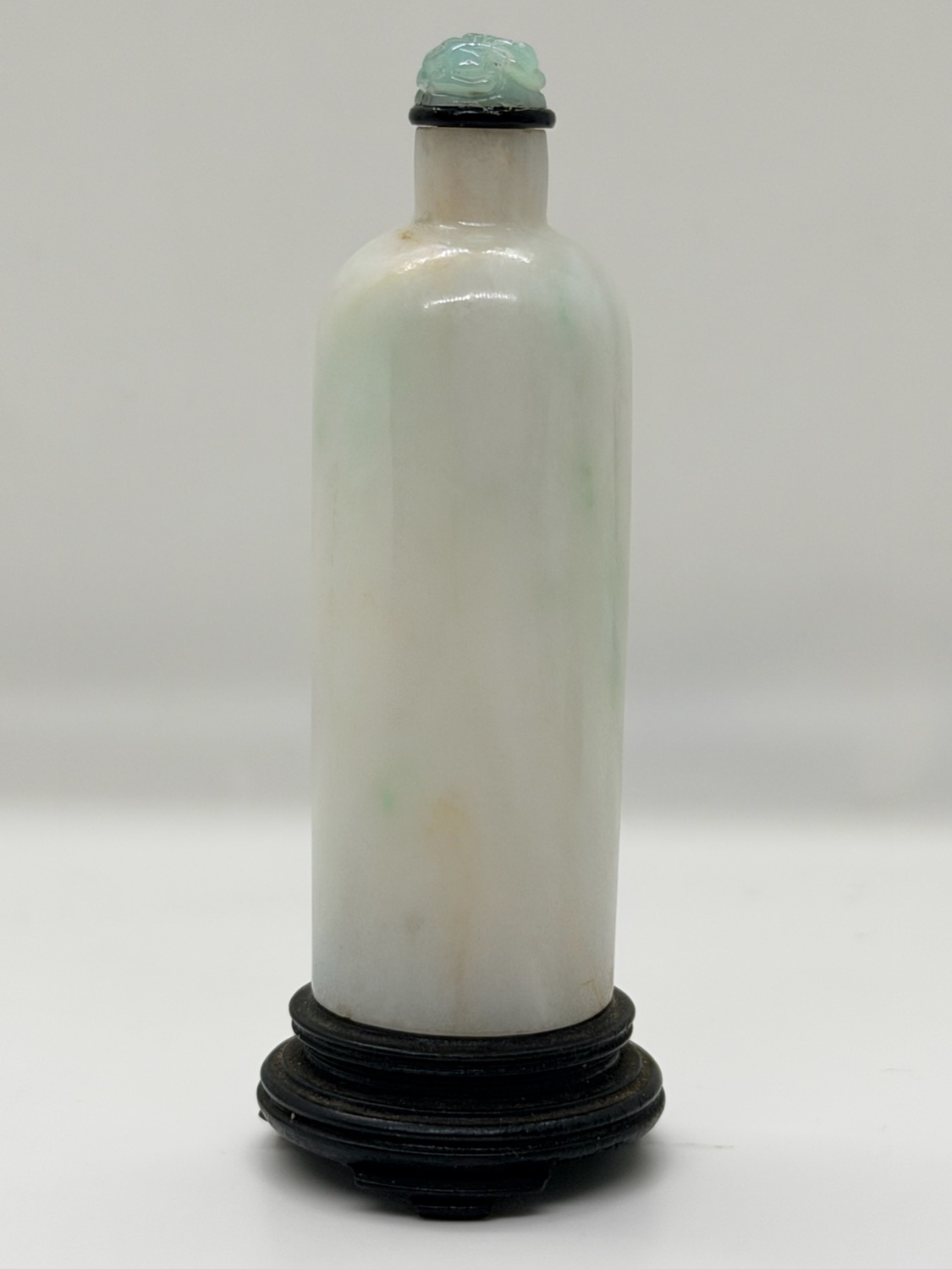
No. 10

Chinese White Jadeite Cylindrical Snuff Bottle with Carved Jadeite Stopper

翡翠白底青花直筒鼻煙壺配翡翠雕蓋

Category
Jade 玉石 · Jadeite 翡翠
Material
Jadeite, white with pale green clouding
Period
Qing dynasty, 19th century
Form
Cylindrical, rounded shoulders
Decoration
Plain, uncarved
Stopper
Carved pale green jadeite stopper, black collar
Height
2.6 in (66 mm), not including stopper
Condition
Minor chip
Provenance
Christie's Swire, Important Chinese Ceramics, Jades and Works of Art, Hong Kong, 1–2 October 1991, lot 1120. From the collection of Joey Silver.
Notes
Well hollowed. Meaning: the bottle is uncarved — purity is its theme. White jadeite touched with drifting green cloud stands for purity and virtue, and the straight cylindrical form, upright and undecorated, speaks of integrity: a scholar's bottle that lets a fine stone and an honest shape carry the whole effect. Comparables: Sotheby's, Hong Kong, Bloch Collection Part IV, 2014, lots 131 and 1014 (plain, extremely well hollowed jadeite group); Christie's, lot-3885983 (rounded cylindrical jadeite, 1800–1860).

A plain snuff bottle of white jadeite with faint pale-green clouding, of straight cylindrical form with rounded shoulders and a short cylindrical neck. The stone is translucent — white with drifting touches of green — and polished smooth, with no carving on the body. The stopper is of pale green jadeite, carved, on a black collar. Well hollowed. Photographed on a black wooden stand, which is not part of the bottle. The base is flat and circular, very slightly concave at the center, the white jadeite showing the faintest green tint at the edge.

The bottle belongs to the group of plain, extremely well hollowed jade bottles that Sotheby's identifies in the Bloch Collection sales: made in a number of workshops over an extended period, the best of them, in Sotheby's judgement, not much later than the Daoguang period. Hollowing is the test of the group, and it tells in this bottle's favour — as Sotheby's notes of a plain jadeite Bloch bottle, a well-hollowed interior worked through a characteristically tiny mouth is "a more arduous task with jadeite than with nephrite because of the additional hardness of the material," and jadeite was usually not well hollowed in the later Qing, so the good hollowing here supports the 19th-century date. The cylindrical form is documented for jadeite of exactly this period: Christie's sold a small rounded cylindrical jadeite bottle in mottled grayish-white stone, dated 1800–1860, comparing a nearly identical bottle in the Bloch Collection (A Treasury of Chinese Snuff Bottles, vol. 1, no. 176). And the stone itself explains the plainness — Sotheby's again: fine jadeite "is always spectacular and usually left undecorated because of the inherent excitement of the stone"; white jadeite with pale green veining is a standard description for bottles dated 1800–1900, as in Bonhams' Wald Collection example.

Meaning: the bottle is uncarved — purity is its theme. White jadeite touched with drifting green cloud stands for purity and virtue, and the straight cylindrical form, upright and undecorated, speaks of integrity: a scholar's bottle that lets a fine stone and an honest shape carry the whole effect.

Provenance: Christie's Swire, Important Chinese Ceramics, Jades and Works of Art, Hong Kong, 1–2 October 1991, lot 1120. From the collection of Joey Silver.


中文說明

翡翠質,清代十九世紀,白底帶淡青花,直筒形,圓肩,短直頸。石質微透,白中浮青,拋光平滑,壺身素面無紋。配淺綠翡翠雕蓋與黑色蓋托。掏膛佳。底部為圓形平底,中心微微內凹,白底翡翠在邊緣透出極淡青色。

此壺屬素面掏膛玉壺一類——蘇富比布洛赫藏品拍賣即以此目之:多家作坊歷時製成,其中佳者據蘇富比判斷不晚於道光時期。掏膛正是此類壺的試金石:蘇富比論一件布洛赫素面翡翠壺時指出,自極小的壺口掏膛本已不易,翡翠硬度又高於軟玉,尤為費工;而晚清翡翠壺多掏膛不佳——此壺掏膛佳,正合十九世紀之斷代。直筒器形於此期翡翠壺亦有先例:佳士得曾售1800至1860年圓筒形翡翠小壺,石色灰白斑駁,並比對布洛赫藏品中一件幾近相同之壺(載《A Treasury of Chinese Snuff Bottles》第一冊第176號)。素面無紋,則因石本身已足動人——蘇富比謂上好翡翠「本身已夠奪目,通常不加雕琢」;白底帶青花的翡翠,邦瀚斯Wald藏品中亦有1800至1900年之例。寓意:此壺素面無紋,所重在純淨。白底翡翠帶淡淡青花,如白玉浮雲,象徵純潔與品德;直筒器形挺立無飾,寓意正直端方——文人之壺,全憑好石與正形取勝。來源:香港佳士得太古洋行「中國陶瓷、玉器及工藝品」拍賣,1991年10月1至2日,拍品1120號;Joey Silver舊藏。

No. 11

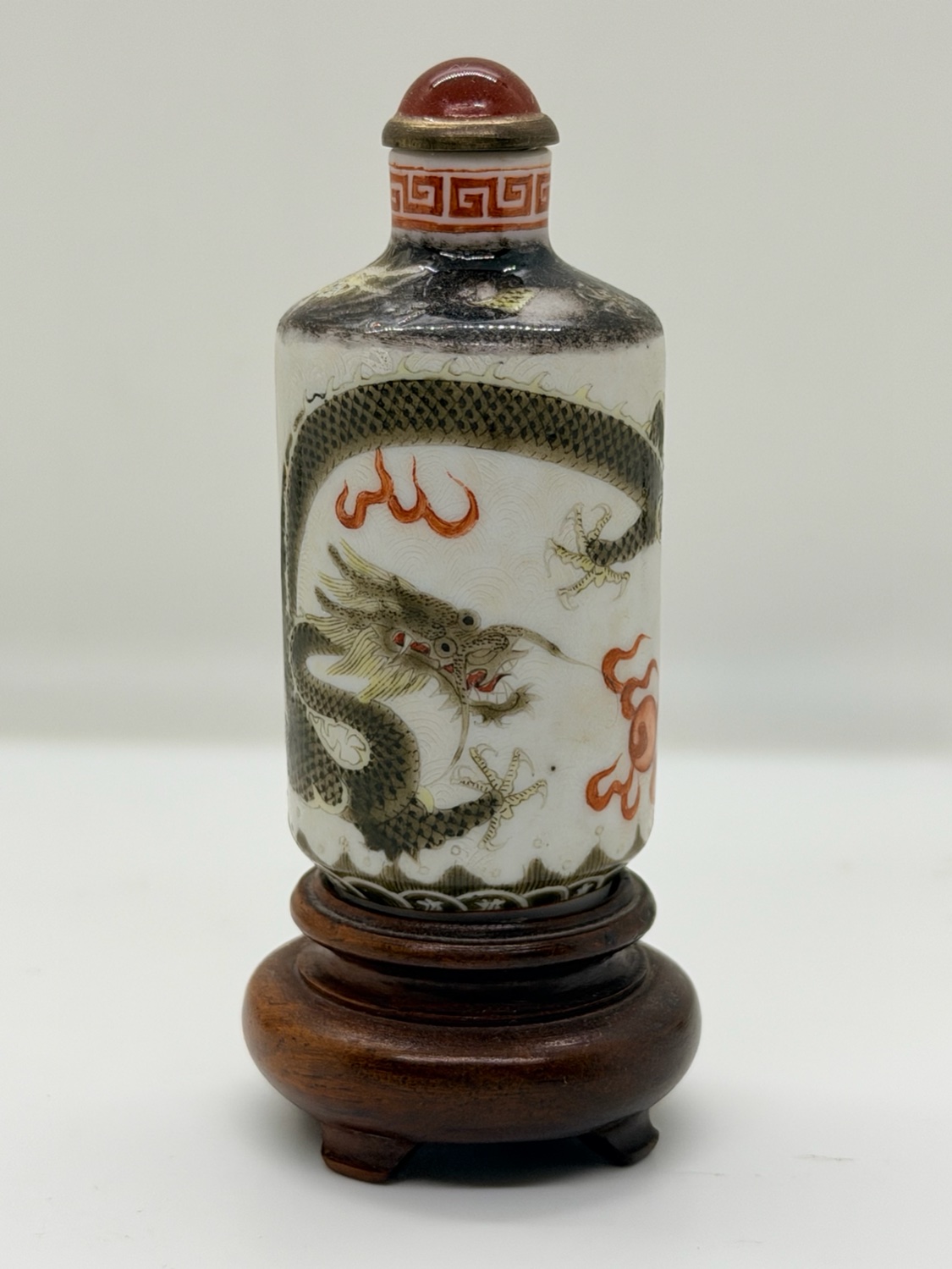
Chinese Famille Rose Porcelain Snuff Bottle with Dragon and Flaming Pearl

粉彩龍戲珠瓷鼻煙壺

Category
Porcelain 瓷器 · Famille rose 粉彩
Material
Porcelain with famille rose enamel decoration
Period
Late 19th–early 20th century
Form
Cylindrical, rounded shoulders
Decoration
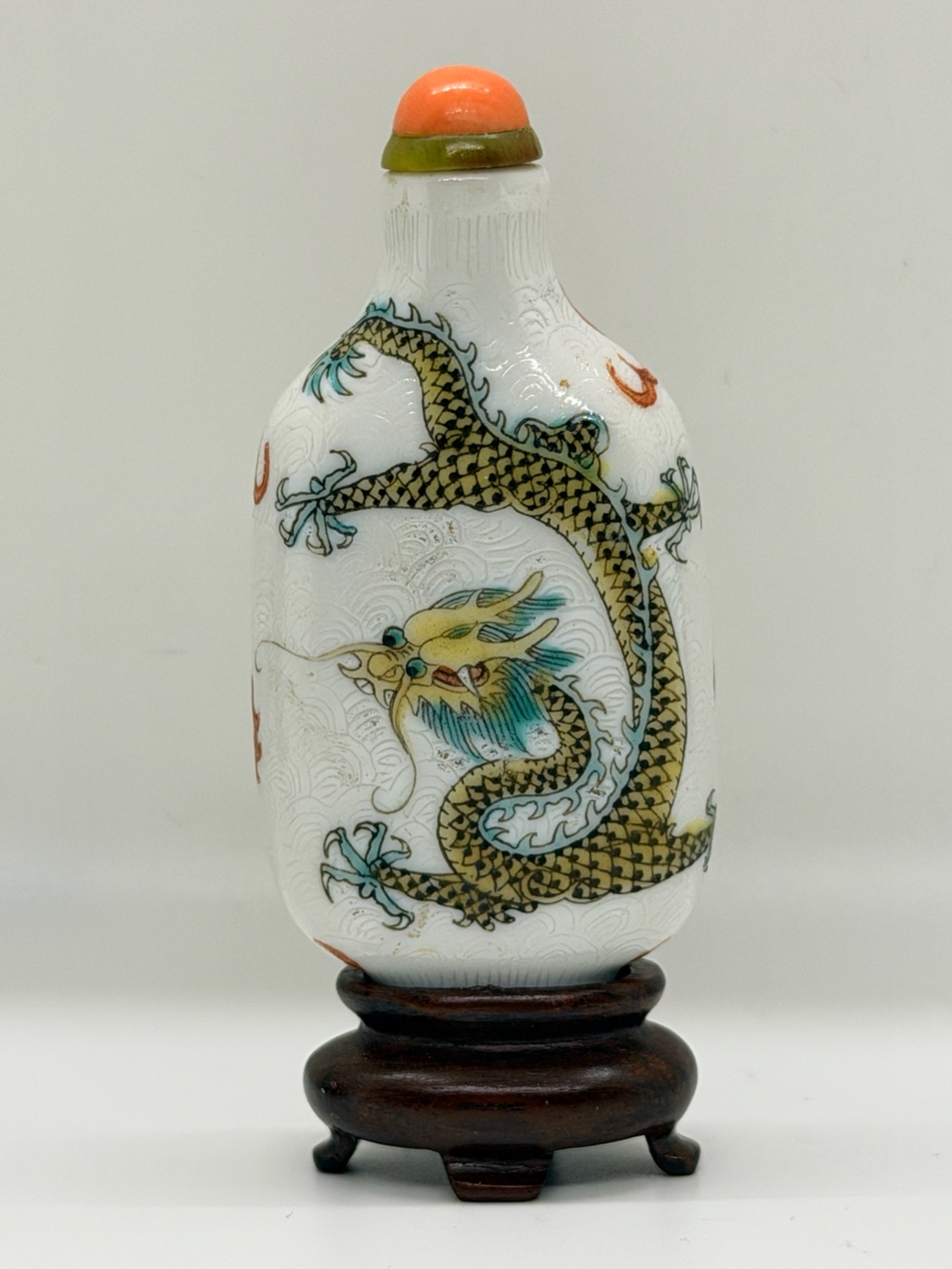
Enamel-painted five-clawed dragon chasing a flaming pearl above waves, key-fret band at the neck
Stopper
Red glass dome stopper, gilt-metal collar
Height
2.4 in (61 mm), not including stopper
Condition
Has a hairline
Notes
Meaning: the dragon is the emblem of imperial power and strength, and a bringer of good fortune. A dragon pursuing the flaming pearl — the wish-granting jewel of wisdom — expresses the pursuit of perfection and the hope that wishes come true; below, the dragon rises from the waves of the sea. Comparables: Bonhams, Hong Kong, 28 Nov 2011, lot 2, and 24 Nov 2012, lot 79 (Daoguang mark-and-period famille-rose dragon bottles); Sotheby's, London, sale L11210, lot 176 (Jiaqing mark-and-period, keyfret neck and wave framing).

A famille rose porcelain snuff bottle of cylindrical form with rounded shoulders, enamel-painted with a five-clawed dragon coiling around the body in pursuit of a flaming pearl, above a band of waves, with dark cloud scrolls at the shoulder and an iron-red key-fret band at the neck. The stopper is a red glass dome on a gilt-metal collar. Photographed on a turned wooden stand, which is not part of the bottle.

The composition is a classic of the Jingdezhen porcelain bottle: a continuous dragon chasing the flaming pearl through clouds above waves, framed by a key-fret border at the neck and the wave band below. Sotheby's Jiaqing mark-and-period famille-rose dragon bottle (London, sale L11210, lot 176) is framed in exactly this way — dragon amid cloud wisps and flame swirls above foaming waves, the neck encircled by keyfret — and the Daoguang mark-and-period examples at Bonhams (Hong Kong, 2011, lot 2, sold HK$75,000; 2012, lot 79, sold HK$87,500) carry the same continuous dragon-and-pearl design. The early 19th-century classics of the type were moulded in relief, a fashion Bonhams notes lost steam in the early Daoguang years as taste turned painterly; a painted dragon, as here, stands later in that line, and the cylindrical form is itself a recognised 19th-century vehicle for the subject — Sotheby's notes cylindrical bottles painted with dragons were made throughout the nineteenth century, and cylindrical famille-rose dragon bottles continued to be produced into the later Qing, as this one was. The five claws carried imperial association, a prerogative Sotheby's notes was gradually abandoned in later Qing art.

Meaning: the dragon is the emblem of imperial power and strength, and a bringer of good fortune. A dragon pursuing the flaming pearl — the wish-granting jewel of wisdom — expresses the pursuit of perfection and the hope that wishes come true; below, the dragon rises from the waves of the sea.

The hairline is a zhadao (扎道): a fine crack confined to the glaze, formed as the piece cools after firing; it does not reach the body, unlike a crack caused by a knock.


中文說明

瓷胎粉彩鼻煙壺,清代晚期至二十世紀初,圓筒形,圓肩,白釉地以粉彩繪五爪龍戲火珠,龍身盤繞壺身,下襯波浪紋,肩部繪墨色雲紋,頸部飾礬紅雷紋一圈。配紅色玻璃蓋與鎏金屬托。

寓意:龍為帝王與力量之象徵,亦主吉祥興旺;龍戲火珠,火珠象徵智慧與如意寶珠,寓追求圓滿、心想事成;下襯海水波浪,龍出大海,氣勢非凡。

此紋飾為景德鎮瓷壺經典圖式:游龍穿雲戲珠、下襯海水,頸以雷紋、底以波浪收邊。蘇富比嘉慶款粉彩龍紋壺(倫敦L11210拍賣第176號)構圖正同——龍戲雲火於怒濤之上,頸繞雷紋;邦瀚斯道光款諸例(香港2011年第2號,成交港幣75,000元;2012年第79號,成交港幣87,500元)亦為通體游龍戲珠。此類壺早期名作多模印浮雕,邦瀚斯指出模印之風於道光初年漸衰,轉尚繪畫——此壺以彩繪為之,正居此脈絡之後段;圓筒形繪龍亦為十九世紀通行器形,蘇富比謂此類圓筒龍紋壺整個十九世紀皆有燒造,晚清續有製作,此壺即其一。五爪本屬御用之制,蘇富比亦指出此等規制於晚清藝術中漸趨鬆弛。

所謂扎道,乃瓷器釉面之細裂紋,多於燒成冷卻時形成,只在釉層,不及胎體,與碰撞所致之沖線有別。

No. 12

Chinese White Nephrite Jade Snuff Bottle with Pink Tourmaline Stopper

白玉素面鼻煙壺配粉紅碧璽蓋

Category
Jade 玉石 · White nephrite 白玉
Material
White nephrite jade
Period
Qing dynasty, 19th century
Form
Globular, tall cylindrical neck
Decoration
Plain, uncarved
Stopper
Pink tourmaline dome stopper
Height
1.75 in (44 mm), not including stopper
Condition
Good
Notes
Good hollowed. Meaning: white jade is the emblem of purity and of the gentleman's virtue. The bottle is uncarved and perfectly rounded, like a pearl or the full moon — its beauty is the stone itself; the single touch of pink at the stopper adds a note of quiet celebration. Comparables: Bonhams, San Francisco, 24 June 2013, lot 1086 (white jade globular bottle, 1760–1840); Bonhams, Hong Kong, 24 Nov 2012, lot 55 (plain white nephrite, 1800–1900); Sotheby's, Hong Kong, Bloch Part X, lot 38 (Treasury, vol. 1, no. 169).

A plain snuff bottle of white nephrite jade, of globular form with a tall cylindrical neck. The stone is an even pale celadon-white, softly translucent with a waxy polish, and entirely uncarved. The stopper is a pink tourmaline dome. Good hollowed.

The plain bottle is a type with a pedigree. Bonhams records that during the Qianlong period a trend developed for plain undecorated bottles, usually in hardstones but predominantly in nephrite, and that the staple of the production was white nephrite of the highest quality and purity — stone that may have become available after 1760, when the Qing boundaries extended to the Khotan jade regions and tribute stone was supplied annually until the Daoguang period. With no carving to judge, a plain bottle stands or falls on its stone, its hollowing and its finish: Bonhams notes the majority of the type are very well hollowed through an unusually narrow mouth, the maker's real display of skill, and catalogues its own globular example (1760–1840, sold US$6,250) on exactly those terms — well hollowed, even white stone, polished to a soft luster. The type did not end with the 18th century: Bonhams has sold a plain white nephrite bottle dated 1800–1900, and Sotheby's Bloch Collection Part X included a plain white jade bottle of the 18th/19th century, extremely well hollowed, published in A Treasury of Chinese Snuff Bottles, vol. 1, no. 169.

Meaning: white jade is the emblem of purity and of the gentleman's virtue. The bottle is uncarved and perfectly rounded, like a pearl or the full moon — its beauty is the stone itself; the single touch of pink at the stopper adds a note of quiet celebration. Photographed on a turned wooden stand, which is not part of the bottle.


中文說明

白玉質,清代十九世紀,圓球形,高直頸。玉色青白均勻,微透,拋光溫潤,壺身素面無紋。配粉紅碧璽蓋。掏膛良好。

素面玉壺自有源流。邦瀚斯指出,乾隆時期興起素面無紋之風,所用多為硬石而以軟玉為主,所取乃最上乘之白玉——此等玉料或於1760年後方充裕供應:清廷版圖擴及和闐產玉之地,貢玉歲入,直至道光年間。素壺無紋可評,成敗全在玉質、掏膛與拋光:邦瀚斯謂此類壺多自極窄之口掏膛精深,正是匠人真功夫;其所售1760至1840年圓球形白玉壺(成交6,250美元),品評亦唯掏膛、玉色均勻、光澤溫潤數事。此風不止於十八世紀:邦瀚斯曾售1800至1900年素面白玉壺,蘇富比布洛赫藏品第十部分亦有十八至十九世紀素面白玉壺,掏膛極精,載於《A Treasury of Chinese Snuff Bottles》第一冊第169號。寓意:白玉象徵純潔與君子之德;器形圓潤如珠如月,素面無紋,全憑玉質本身取勝;一點粉紅蓋色,添喜氣而見雅緻。

No. 13

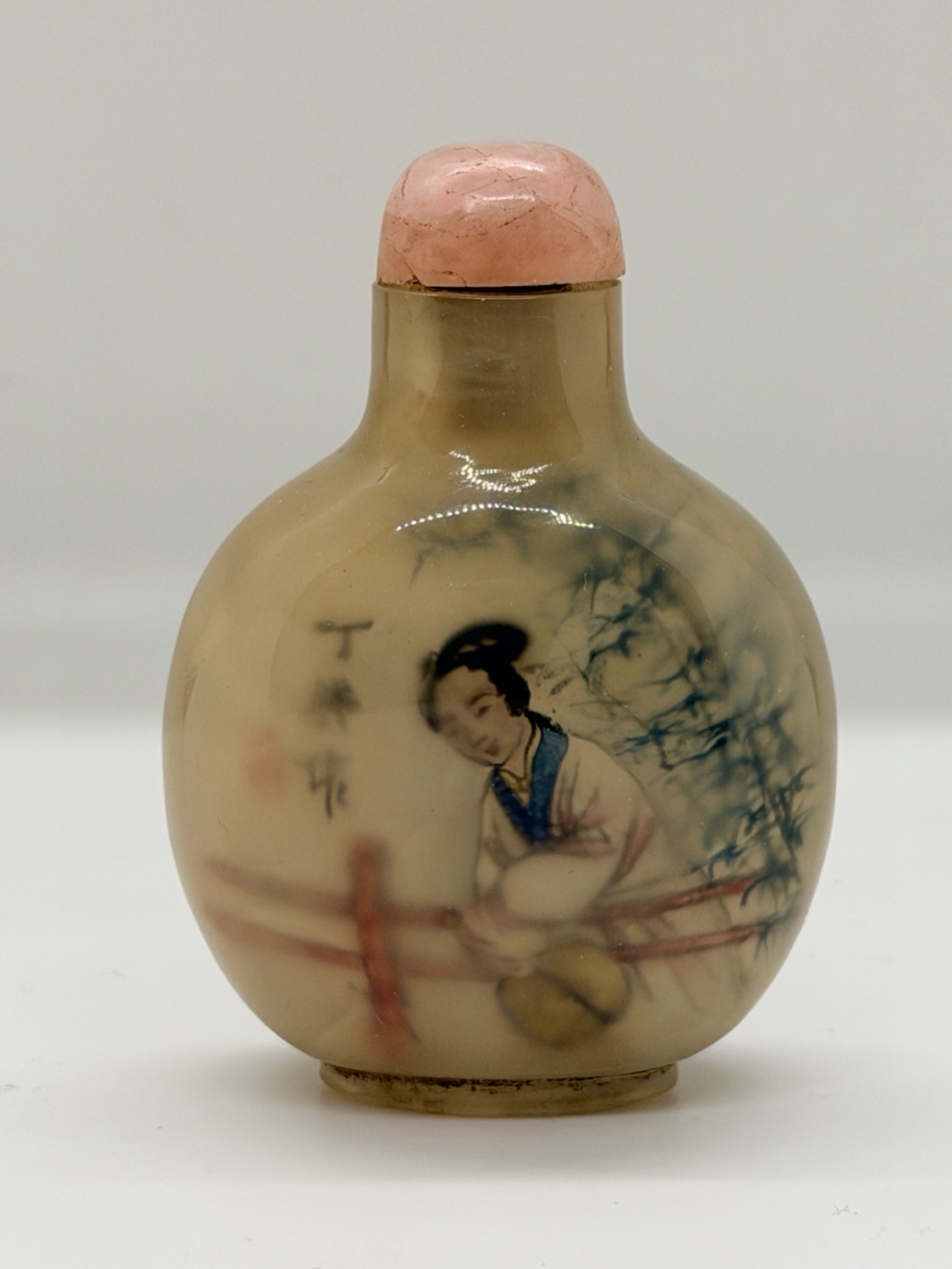
Chinese Inside-Painted Agate Snuff Bottle with Ladies in a Garden

瑪瑙內畫仕女圖鼻煙壺

Category
Agate & Chalcedony 瑪瑙 · Inside-painted 內畫
Material
Agate (chalcedony), inside-painted
Period
Mid-20th century, c. 1960s
Form
Flattened globular, cylindrical neck, flat oval foot
Decoration
Inside-painted: a lady leaning on a garden fence beside bamboo, inscription and red seal; reverse, a lady in red jacket and green skirt by rockwork — signed Ding Hong (丁洪作)
Stopper
Pink tourmaline dome stopper
Height
2 in (51 mm), not including stopper
Condition
Good
Notes
Good hollowed. Signed 丁洪作 — painted by the artist Ding Hong (丁洪). Ding Hong is an alternative name of Ding Guiling (丁桂玲), a female artist of the Beijing Ye school: apprenticed to the Ye family in 1960, she was a student of Ye Bengqi (葉菶祺), third son of the master Ye Zhongsan, and was active in Beijing from the 1960s. Her signed bottles are recorded at Bonhams and Sotheby's, including an inside-painted agate bottle signed Ding Hong (Bonhams, London, 2024). The base is incised with a seal-script mark reading 芬芳 (fenfang, 'fragrance') — a fitting word for a bottle made to hold scented snuff. Meaning: the ladies in a garden stand for the grace and leisure of the inner court and the beauty of youth; the bamboo beside them is integrity and quiet refinement. An inside painting is seen through the translucent stone, solid and void at once — a small world held in the palm. Base marks of this kind on Qing and Republic-period bottles are hall marks, workshop marks, or personal seal marks — usually the craftsman's or painter's alias, or the studio name of the person who commissioned the piece — and 芬芳 ('fragrance') also carries an auspicious meaning; such marks are often found on the bases of inside-painted bottles and of jade and agate wares. Further records: Hindman, Chicago, 23–24 Mar 2015, lot 468 (Ding Hong glass bottle, ladies in a garden on both faces); Bonhams, New York, 19 Mar 2018, lot 8010 (Ding Guiling smoky quartz, dated 1972, sold US$1,000); Bonhams, Paris, 12 Dec 2025 (a second Ding Hong agate bottle, ex-Christie's London, 4 Apr 1979, lot 111). Sotheby's (Bloch Part X, lot 69 note) records that in October 1960 Ding Guiling and Liu Shouben were re-assigned to the workshop where the Ye brothers worked and taught; Bonhams names her among the four artists taught by Ye Xiaofeng and Ye Bengqi.

An inside-painted snuff bottle of translucent pale agate, of flattened globular form with a cylindrical neck and a flat oval foot. One face is painted from inside with a lady leaning on a garden fence beside bamboo, the signature 丁洪作 ('by Ding Hong') and a red seal at the side; the reverse shows a second lady in a red jacket and green skirt standing by rockwork. The stopper is a pink tourmaline dome. The base is incised with a seal-script mark reading 芬芳 (fenfang, 'fragrance'). Good hollowed. The painting is mid-20th century work by Ding Guiling (丁桂玲) of the Beijing Ye school, who signed as Ding Hong.

The subject is a documented Ding Hong theme: Hindman, Chicago, sold an inside-painted glass bottle signed Ding Hong painted with ladies in a garden on both faces — a lady standing under bamboo in a garden on one side, a second lady seated with a fan on the other. Her career is anchored in the Ye family workshop: Sotheby's records that in October 1960 Ding Guiling was re-assigned, with Liu Shouben, to the inside-painted workshop where the Ye brothers worked and taught, and Bonhams names her among the four artists taught by Ye Zhongsan's sons Ye Xiaofeng and Ye Bengqi — Liu Shouben, Wang Xisan, Ye Shuyin and Ding Guiling. Painting on agate was standard practice for that cohort: signed Ding Hong agate bottles appear at Bonhams London (2024) and again at Bonhams Paris (2025, the bottle with earlier provenance to Christie's London, 1979), Liu Shouben painted on agate around 1970, and Ye Xiaofeng on agate in 1955–1960 — the painting of an older hardstone bottle, as here, is characteristic of the school. Bonhams' records of her signed work in other materials run from the 1960s into the 1970s, including a smoky quartz bottle of 1972 signed in full as Ding Guiling and sold in New York in 2018 for US$1,000.

Meaning: the ladies in a garden stand for the grace and leisure of the inner court and the beauty of youth; the bamboo beside them is integrity and quiet refinement. An inside painting is seen through the translucent stone, solid and void at once — a small world held in the palm.


中文說明

瑪瑙質,二十世紀中期(約1960年代),扁圓形,直頸,橢圓形圈足。壺身微透,內畫一面繪仕女倚欄臨竹,旁有「丁洪作」款及紅色印章;另一面繪紅衣綠裙仕女立於湖石之旁。配粉紅碧璽蓋。壺底陰刻篆書「芬芳」二字款。掏膛良好。

寓意:仕女圖象徵閨閣之雅與青春之美;竹喻節操與清高;內畫隔石觀畫,虛實相生,為掌中一方小景。

此題材於丁洪作品中有案可稽:芝加哥Hindman曾售丁洪款內畫玻璃壺,兩面皆繪庭園仕女——一面仕女立於竹下,一面仕女坐而執扇,與此壺相類。其師承則在葉氏作坊:蘇富比記載,1960年10月丁桂玲與劉守本同被調入葉氏兄弟任教的內畫作坊;邦瀚斯亦列其名於葉仲三之子葉小峰、葉菶祺門下四人之中(劉守本、王習三、葉淑英、丁桂玲)。以瑪瑙為胎作畫,乃此派常規:丁洪款瑪瑙內畫壺見於邦瀚斯倫敦(2024年)及巴黎(2025年,後者早年出處為佳士得倫敦1979年)拍賣,劉守本約1970年、葉小峰1955至1960年間亦皆以瑪瑙作畫——借舊石胎施新繪,正是葉派特色。丁洪其他材質署名作品,邦瀚斯紀錄由1960年代延至1970年代,包括1972年茶晶壺一件,具名丁桂玲,2018年於紐約售出1,000美元。清代及民國鼻煙壺的這類底款,多屬堂名款、作坊款或人名印款,或為工匠畫師別號,或為訂製者齋號,並寓「芬芳」吉祥之意;內畫壺及玉石、瑪瑙器物底部常見此類款識。畫家丁洪即丁桂玲,京派葉派女畫家,1960年入葉氏門下,為葉仲三三子葉菶祺弟子,1960年代起活躍於北京;其署名作品見於邦瀚斯、蘇富比拍賣,邦瀚斯2024年倫敦拍品中亦有一件丁洪款瑪瑙內畫壺。

No. 14

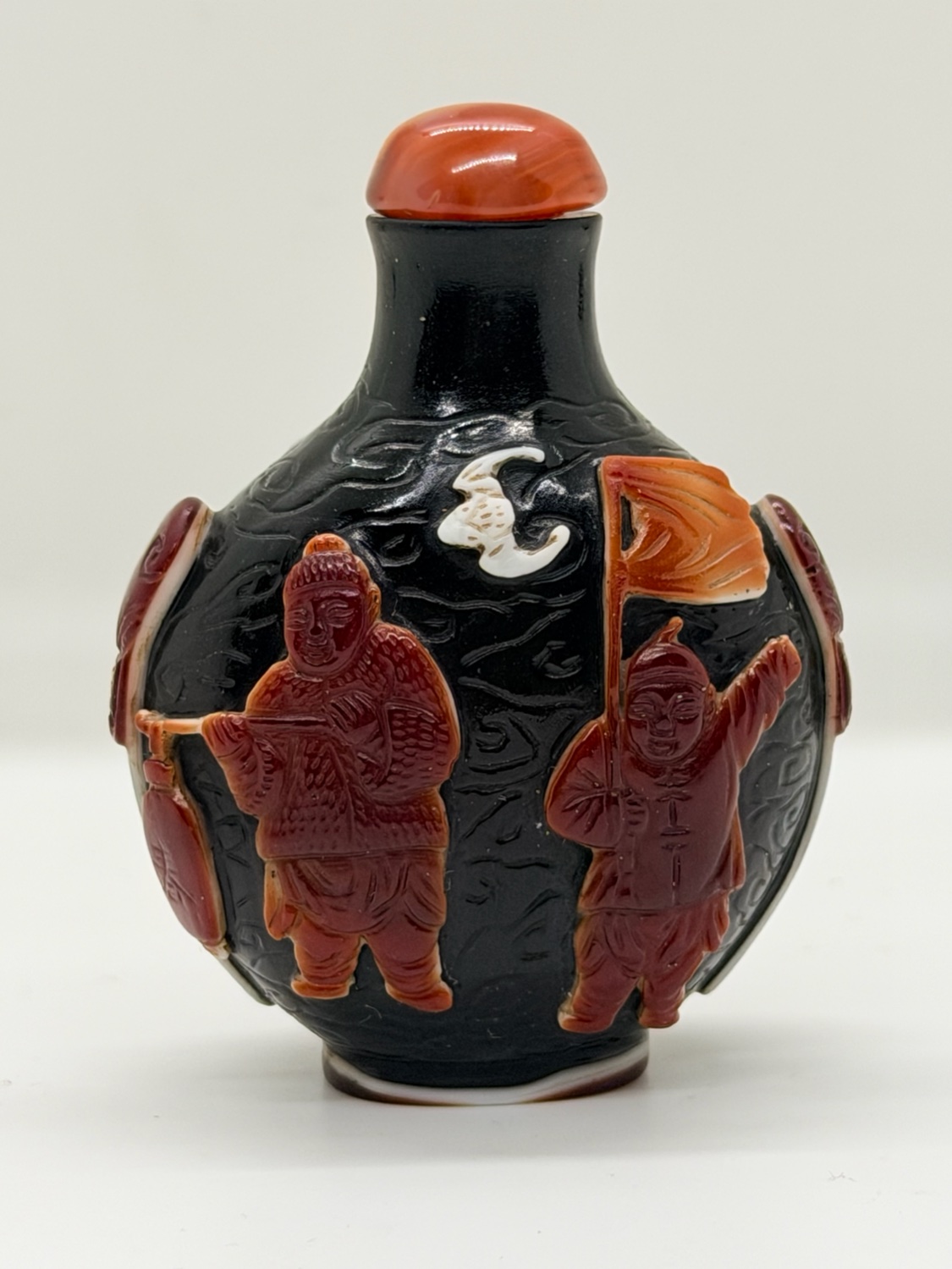
Chinese Cameo Glass Snuff Bottle with Warriors and Water Buffalo

紅白套黑地玻璃人物水牛紋鼻煙壺

Category
Glass 玻璃 · Overlay glass 套玻璃
Material
Cameo overlay glass — carnelian-red and white overlays on an opaque black ground
Period
Qing dynasty, 19th century
Form
Globular with cylindrical neck and oval footring
Decoration
Cameo-carved in the red and white overlays: one face with two warrior figures, one in scaled armor and one holding a tall banner, a white bat above; the reverse with a water buffalo flanked by two figures beneath white cloud scrolls; the black ground carved with cloud scrolls; red panels at the sides
Stopper
Carnelian-red glass dome
Height
Approx. 2 in (51 mm), not including stopper
Condition
Good
Notes
Hollowing: Good hollowed. Meaning: the bat (蝠) puns on fu (福), good fortune, and the cloud scrolls bring heavenly blessings; the water buffalo stands for strength, spring and plenty; the banner-bearing warriors suggest rank and victory — an auspicious, martial wish worked in layered glass. Technique: blown and cameo carved through the overlay layers (Corning Museum of Glass, accession 2023.6.5, probably Yangzhou, 1800–1880). Multi-colour overlay on a black ground is described by Christie's as a rare variant (Holden Collection, lot 816, Yangzhou, 1780–1881, sold US$21,420); buffalo-and-bats composition parallels: Holden lot 838 (1840–1880, sold US$27,720) and the Bloch Collection three-colour overlay buffalo bottle (Bonhams, lot 122, probably Yangzhou, 1861–1883). No exact warrior-subject parallel was located in this research; the nearest martial parallel is a Yangzhou-school overlay bottle with immortal warriors amidst clouds, 1800–1850 (Christie's, lot-928747, sold US$4,025).

A cameo glass snuff bottle of globular form with a cylindrical neck, Qing dynasty, 19th century. On an opaque black ground carved with cloud scrolls, the carnelian-red and white overlays are cameo-carved: one face with two warrior figures — one in scaled armor, the other holding a tall banner — beneath a white bat; the reverse with a large water buffalo flanked by two figures beneath white cloud scrolls, with red panels at the sides. The stopper is a carnelian-red glass dome.

The technique is the one the Corning Museum of Glass catalogues for this type: blown, then cameo carved, the design cut down through the coloured overlay layers so that the figures stand in relief against the dark ground. Multi-colour overlay on a black ground is the rare variant of the art — Christie's, cataloguing the Holden Collection's red-overlay black glass bottle (Yangzhou, 1780–1881; sold US$21,420), calls it a rare example, lighter grounds being far commoner because the overlay colours read more easily against them. The dated parallels cluster in Yangzhou production of the 19th century: the Holden sale's companion bottle (1840–1880, sold US$27,720) pairs water buffaloes and figures with bats flying above, exactly the company kept here, and the Bloch Collection's three-colour overlay bottle of herdboys on buffaloes beneath two flying bats and the sun (probably Yangzhou, 1861–1883) repeats the buffalo-bat-sun grouping on a bottle carved, like this one, as a double overlay. Buffalo, figures, a bat and cloud scrolls together are a period Yangzhou composition, not an anomaly.

Meaning: the bat (蝠) puns on fu (福), good fortune, and the clouds bring heavenly blessings; the buffalo stands for strength, spring and plenty, and the banner-bearing warriors for rank and victory — an auspicious, martial wish worked in layered glass.


中文說明

清代十九世紀,黑地套紅白玻璃鼻煙壺,球形,直頸,橢圓圈足。黑地淺刻雲紋,紅白套料浮雕:一面刻兩名武士,一人身披鱗甲,一人高擎旗幟,上有白蝠;另一面刻一頭大水牛,兩側有人物,上有白色祥雲,兩側有紅色開光。蓋為紅玻璃圓頂。

其法即康寧玻璃博物館著錄此類壺所用之語:先吹製成胎,再以浮雕法(cameo)逐層剔刻套料,使人物自深色地上凸起。多色套料而以黑為地者最為罕見——佳士得品評侯頓(Holden)藏品中1780至1881年揚州黑地紅套壺(成交21,420美元)時即稱之為稀例,因淺色地較常見,套色於淺地上更易分明。有紀年之同類作品多歸揚州十九世紀製品:同場另一件1840至1880年作(成交27,720美元),正以水牛、人物與空中飛蝠相配,與此壺若合符節;布洛赫舊藏三色套料水牛壺(約揚州,1861至1883年),牧童騎牛,上有雙蝠與日,同為雙層套料浮雕。牛、人物、蝠與雲紋並置,乃揚州套玻璃之時代圖式。蝠諧音「福」,祥雲帶來天賜之福;水牛象徵力量、春耕與豐足,擎旗武士象徵功名與勝利,寓意吉祥。

No. 15

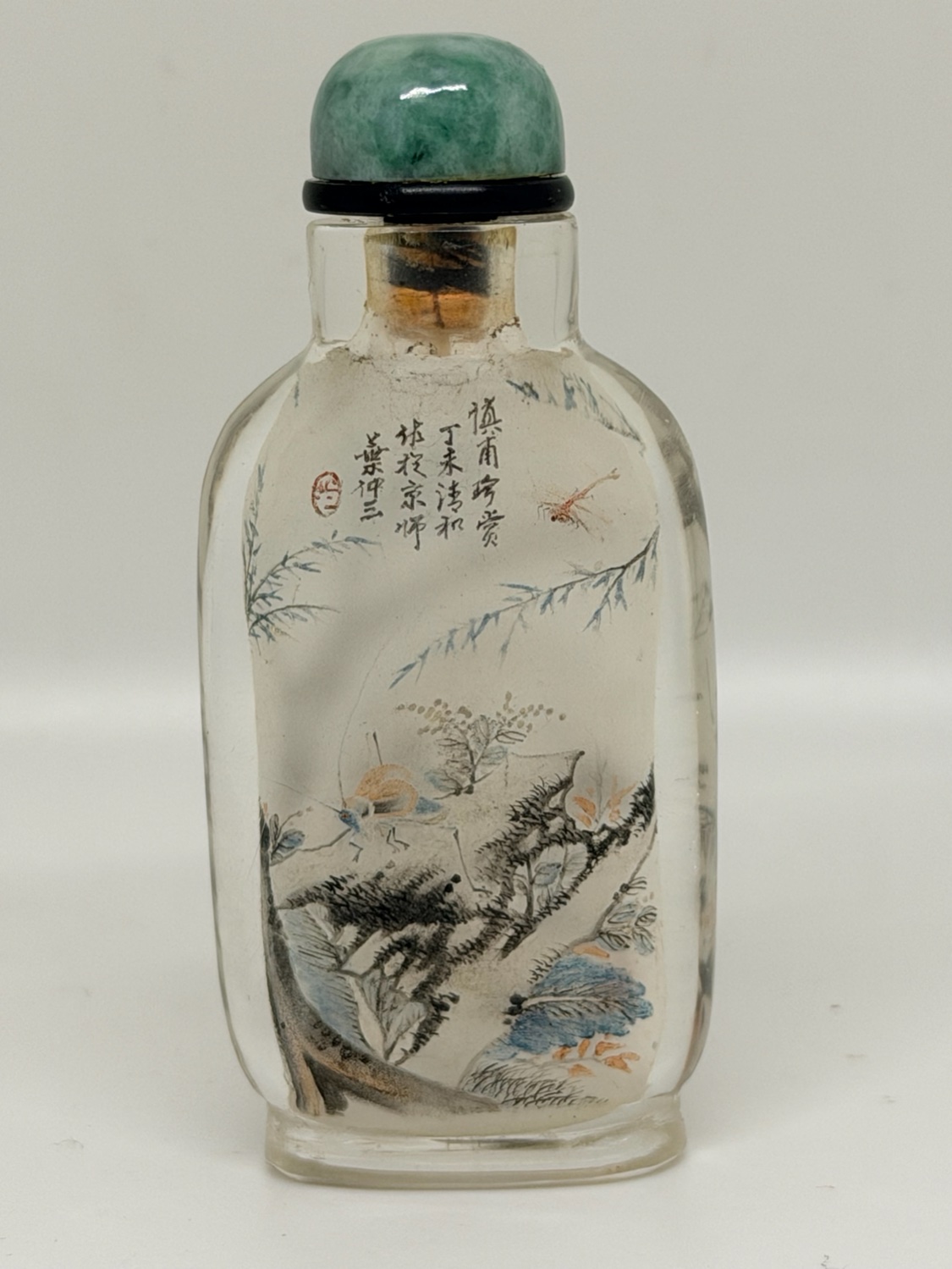
Chinese Inside-Painted Rock Crystal Snuff Bottle with Insects and Goldfish, Signed Ye Zhongsan

水晶內畫草蟲金魚鼻煙壺葉仲三款

Category
Crystal & Quartz 水晶 · Inside-painted 內畫
Material
Inside-painted rock crystal
Period
Dated dingwei (1907)
Form
Flattened rectangular with rounded shoulders, cylindrical neck and flat oval foot
Decoration
Inside-painted: one face with insects among plants and rockwork, with a calligraphic inscription and a red seal; the reverse with a willow over a stream bank, an insect on the slope and goldfish swimming below — inscribed with a dingwei date and signed Ye Zhongsan (葉仲三)
Stopper
Green jadeite dome with black collar
Height
2.3 in (58 mm), not including stopper
Condition
Good
Notes
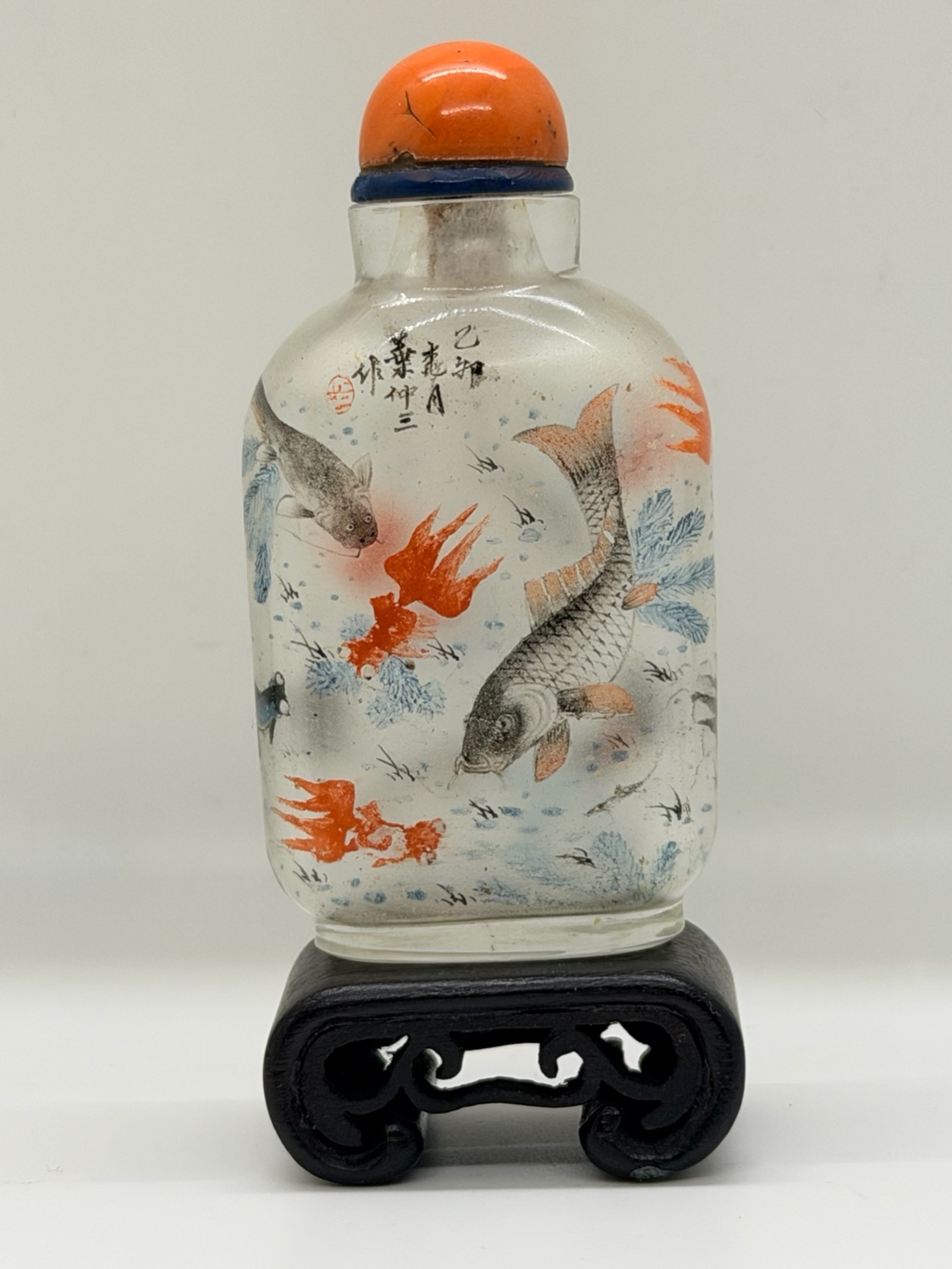
Signed 葉仲三 (Ye Zhongsan, 1875–1940), the founding master of the Beijing school of inside painting, and dated by inscription to the dingwei year (1907). Meaning: goldfish (金魚) pun on jin yu (金玉), gold and jade — abundance; insects among the plants (草蟲) celebrate the small life of the garden, closely observed; the willow is spring and renewal. Inscription: 慎甫珍賞,丁未清和,作於京師,葉仲三 — 'Treasured by Shenfu; in the qinghe month of the dingwei year, made in the capital; Ye Zhongsan.' Comparables: Christie's, J & J Collection, lot-5108600 (crystal, dated 1897, same insects-and-goldfish subject; J & J Collection, vol. 2, no. 433); Bonhams, Hong Kong, 28 Nov 2011, lot 83 (dated 1904; Treasury, vol. 4, no. 526); Bonhams, Hong Kong, 24 Nov 2012, lot 31 (rock crystal, dated 1907, sold HK$137,500). Christie's records Ye was still working alone in 1904, his sons joining only about 1913, so the 1907 date places this bottle in his solo period.

An inside-painted rock crystal snuff bottle of flattened rectangular form, dated dingwei (1907) and signed Ye Zhongsan (葉仲三). The inscription reads: 「慎甫珍賞,丁未清和,作於京師,葉仲三」 ('Treasured by Shenfu; in the qinghe month of the dingwei year, made in the capital; Ye Zhongsan'). One face is painted with insects among plants and rockwork, with the inscription and a red seal; the reverse with a willow leaning over a stream bank, an insect on the slope and goldfish swimming below. The stopper is a green jadeite dome with a black collar.

The subject — insects among plants above, goldfish in the water below — is one of Ye's signature compositions. Christie's, cataloguing the J & J Collection's crystal bottle of 1897 with the same pairing (published in The Art of the Chinese Snuff Bottle. The J & J Collection, vol. 2, no. 433), records that Ye borrowed the subject from Zhou Leyuan and returned to it repeatedly in the 1890s, his own handling more descriptive than Zhou's, with greater emphasis on outline and detail — the manner that grew into the Ye family's decorative style. The willow on the reverse is a documented variant of the composition: Bonhams, cataloguing Ye's 1904 version of the subject (Treasury, vol. 4, no. 526), notes the willow had been added to it at least as early as 1898. The date matters for the hand: Christie's records that Ye was still working alone in 1904 and that the first of his sons did not join him in producing works under his name until about 1913, so a bottle of 1907 is Ye's own work from his solo years — as are his other recorded bottles of that year, among them an inside-painted hair crystal bottle of goldfish and carp (Bonhams, New York, 2017) and a carved and inside-painted rock crystal bottle (Bonhams, Hong Kong, 2012, sold HK$137,500).

Goldfish (金魚) pun on jin yu (金玉), gold and jade — a wish for abundance; the insects among the plants (草蟲) celebrate the small life of the garden, closely observed, and the willow is spring and renewal. Ye Zhongsan (1875–1940) was the founding master of the Beijing school of inside painting: self-taught in the art, he founded the Ye family school and trained his sons and a generation of painters, and a bottle painted by his own hand in 1907, as here, is his mature work.


中文說明

水晶內畫鼻煙壺,扁方形,圓肩,直頸,平底。丁未年(1907)作,署葉仲三款,鈐紅印。題款全文:「慎甫珍賞,丁未清和,作於京師,葉仲三。」一面繪草蟲花石,另一面繪垂柳溪岸,坡上有草蟲,水中有金魚。蓋為翡翠圓頂配黑圈。

草蟲在上、金魚在下,乃葉仲三代表性圖式。佳士得品評J & J藏品1897年水晶壺(同為此圖式,載Moss、Graham、Tsang《The Art of the Chinese Snuff Bottle. The J & J Collection》第二冊第433號)時指出:此題材本自周樂元,葉氏於1890年代屢屢重繪,而其筆法較周氏更重描寫、輪廓與細節,後遂成葉派裝飾風格。背面之垂柳亦有先例:邦瀚斯品評葉氏1904年同題材之作(《Treasury》第四冊第526號)時謂垂柳入畫至遲始於1898年。紀年更關乎手筆:佳士得記載,葉仲三1904年時仍獨自作畫,其子輩至約1913年方加入以其名義製作——故1907年之壺乃其獨作時期親筆;同年作品另見邦瀚斯紐約所售髮晶金魚壺,及香港所售雕刻兼內畫水晶壺(成交港幣137,500元)。金魚諧音「金玉」,寓意富足;草蟲寄託對園中微物的細察之趣,垂柳象徵春意與新生。葉仲三(1875–1940)為京派內畫創始人,自學成家,創立葉派,子侄門人輩出,為一代宗師;此壺作於1907年,正值其盛年手筆。

No. 16

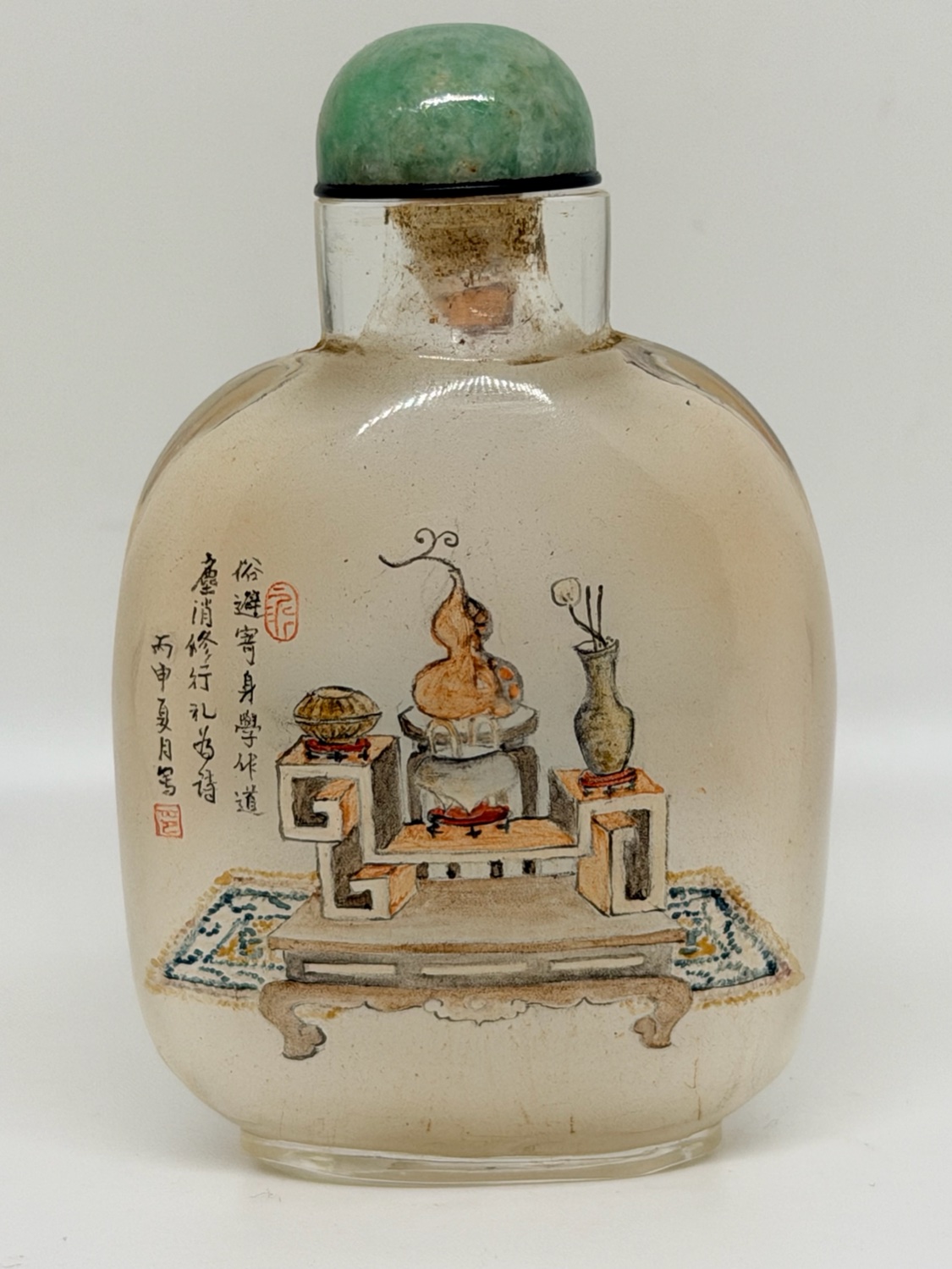
Chinese Inside-Painted Glass Snuff Bottle with Scholar's Altar and Seated Scholar, Attributed to Sun Xingwu

玻璃內畫清供人物鼻煙壺孫星五款

Category
Glass 玻璃 · Inside-painted 內畫
Material
Inside-painted glass
Period
Dated bingshen (1896)
Form
Flattened ovoid with cylindrical neck and flat oval foot
Decoration
Inside-painted: one face with a scholar's altar arrangement (qinggong) — a double gourd on a stand, a covered bowl and a vase with implements on a table over a patterned carpet — with a couplet inscription and two seals; the reverse with a bearded scholar in blue robes seated on a woven mat inside curtained quarters, books, a vase with prunus and a teapot beside him
Stopper
Green jadeite dome with black collar
Height
2.5 in (64 mm), not including stopper
Condition
Good
Notes
Attributed to Sun Xingwu (孫星五), a Beijing inside painter inspired by Zhou Leyuan, whose dated works survive only from 1894 to 1900; the bingshen date (1896) falls squarely in his short career, and some sixty-five of his bottles are recorded, several published in A Treasury of Chinese Snuff Bottles, vol. 4. Inscription: 俗避寄身學作道,塵消修行禮尚詩。丙申夏月寫 ('Shunning the common world, I lodge my life in learning the Dao; the dust of the world dispelled, cultivation honors ritual and poetry. Written in a summer month of bingshen'). Meaning: the double gourd (葫蘆) is a Daoist emblem of longevity and protection, its name punning on fu lu (福祿), good fortune and rank; the altar arrangement and the scholar at his books paint the cultivated life the couplet praises. Couplet explained: the first line — shunning the common world, the sitter lodges his life in quiet retreat and learns to follow the Dao; the second — with the dust of the world dispelled, he devotes himself to cultivation, still honouring ritual and poetry. No earlier source for the couplet has been found; it appears to be an original studio couplet composed for the bottle. Comparables: Bonhams, Hong Kong, 27 May 2012, lots 113 (dated 1895; Treasury, vol. 4, no. 565; sold HK$60,000) and 91 (dated 1897; Treasury, vol. 4, no. 567; sold HK$47,500); Bonhams, New York, 21 Mar 2023, lot 393 (dated 1896, the same bingshen year); Sotheby's, Hong Kong, Bloch Part IV, lot 112 (Treasury, vol. 4, no. 568). Note on the recorded-output count: the Treasury-based figure in the existing Notes is sixty-five bottles; Bonhams (New York, 2023, lot 392 footnote) gives 'almost one hundred' — the counts differ by source and both are auction-house statements. No Sun Xingwu bottle with a qinggong (scholar's altar) subject was located in this research; the comparables support the artist, dating, inscription practice and calligraphy.

An inside-painted glass snuff bottle of flattened ovoid form, dated by inscription to a summer month of the bingshen year (1896) and attributed to Sun Xingwu (孫星五) of Beijing. One face is painted with a scholar's altar arrangement — a double gourd on a stand, a covered bowl and a vase with implements on a table over a patterned carpet — beside the couplet inscription and two seals; the reverse with a bearded scholar in blue robes seated on a woven mat within curtained quarters, books, a vase with a prunus branch and a teapot around him. The inscription reads: 「俗避寄身學作道,塵消修行禮尚詩。丙申夏月寫。」 ('Shunning the common world, I lodge my life in learning the Dao; the dust of the world dispelled, cultivation honors ritual and poetry. Written in a summer month of bingshen.') The stopper is a green jadeite dome with a black collar. The double gourd is a Daoist emblem of longevity and protection, its name punning on fu lu (福祿), good fortune and rank; altar and scholar together paint the cultivated life the couplet praises. The couplet is the sitter's motto — Daoist withdrawal and cultivation on one side, Confucian ritual and poetry on the other — and the bottle's two faces, the altar and the scholar, paint that same ideal. No earlier source for the couplet is known; it was likely composed for this bottle.


中文說明

玻璃內畫鼻煙壺,扁圓形,直頸,平底。丙申年(1896)夏月作,傳為北京內畫家孫星五所繪。一面繪文人清供:几案之上,中央供雙葫蘆,左置蓋碗,右設瓶插,案下鋪花毯,旁題聯語並鈐印二方;另一面繪一長髯文士,身著藍袍,趺坐蒲團之上,帷幔低垂,身旁有書冊、梅瓶與茶壺。題款:「俗避寄身學作道,塵消修行禮尚詩。丙申夏月寫。」蓋為翡翠圓頂配黑圈。葫蘆諧音「福祿」,為道家吉祥之物,象徵長壽與護佑;清供與高士圖,正是題聯所頌的修養生活。聯語釋義:上聯謂避開塵俗、寄身清靜、學作修道之人;下聯謂塵慮消盡、專心修行、崇尚禮詩。此聯未見古籍出處,當為畫家或訂製者自撰之書齋聯;一面清供屬道,一面高士屬儒,正合聯意。

No. 17

Chinese Smoky Quartz Snuff Bottle with Inscriptions and Prunus Panel

茶晶刻字梅花鼻煙壺

Category
Crystal & Quartz 水晶 · Smoky quartz 茶晶
Material
Smoky quartz
Period
Qing dynasty, 19th century
Form
Rectangular with panelled faces, cylindrical neck
Decoration
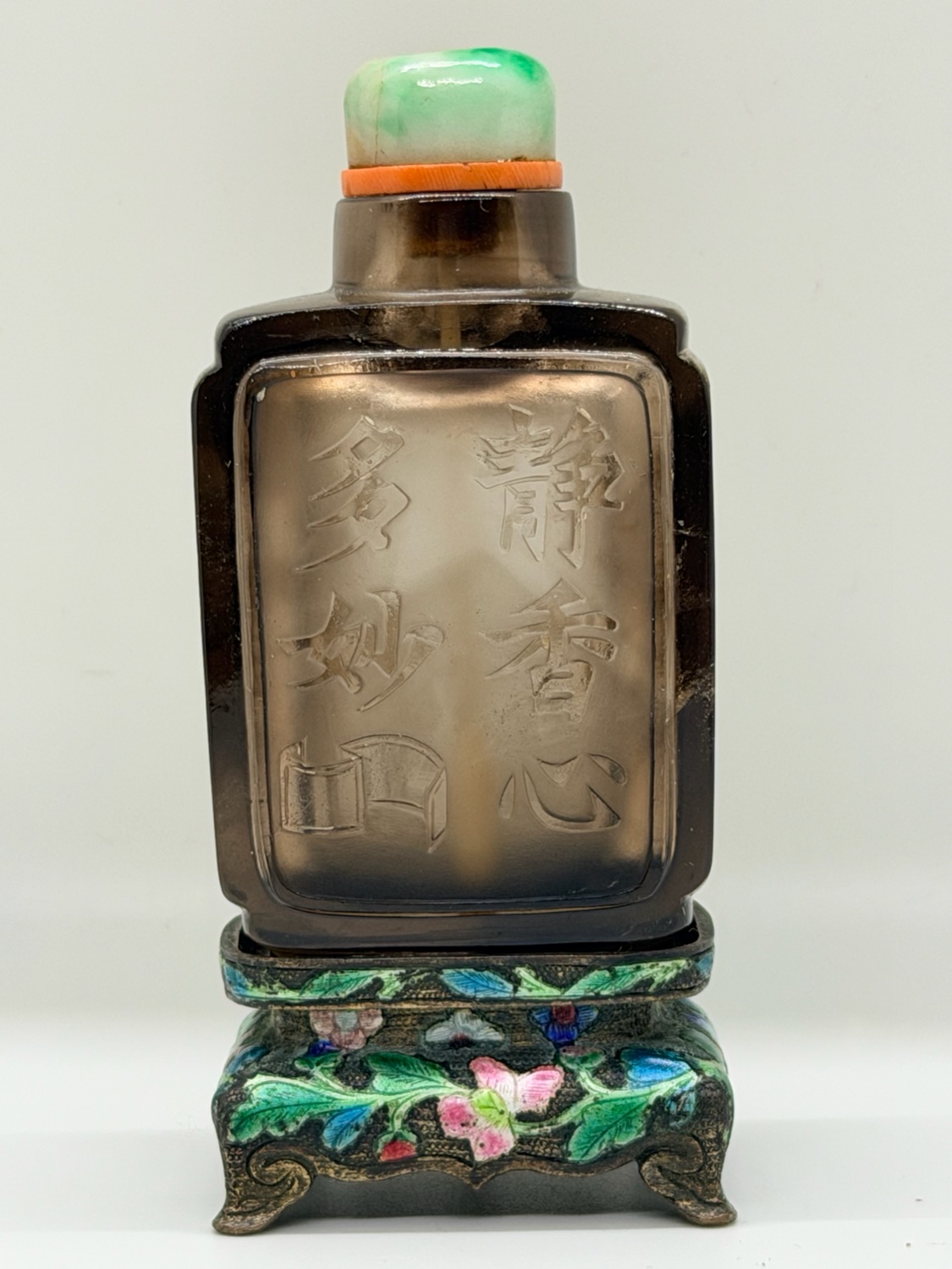
Each face a recessed panel: the front carved with the five characters 靜香心多妙 in large script; the back with a prunus branch in low relief; one narrow side inscribed 幾生修得到梅花 — the line from the Southern Song poet Xie Fangde's (謝枋得) poem 'In the Wuyi Mountains' (武夷山中): 'through how many lifetimes of cultivation does one attain the plum blossom' — with an oval seal-script leisure seal below; the other narrow side inscribed 香雪海 ('Fragrant Snow Sea') in seal script, with two small seal-script seals at the left below. Photographed on an enamel stand (not part of the bottle)
Stopper
Pale green jadeite, coral-red collar
Height
2.3 in (58 mm), not including stopper
Condition
Good
Notes
Hollowing: Well hollowed. Inscriptions: the front panel reads 靜香心多妙 ('a still, fragrant heart — so full of wonder'); one narrow side reads 幾生修得到梅花 — the line from the Southern Song poet Xie Fangde's (謝枋得) poem 'In the Wuyi Mountains' (武夷山中): 'through how many lifetimes of cultivation does one attain the plum blossom' — the 梅 is written with the variant 毎 component and 花 in a cursive hand, and below is an oval white-text seal-script leisure seal, possibly reading 雅玩 ('elegant enjoyment') or 清賞 ('pure appreciation'); the other narrow side is inscribed 香雪海 ('Fragrant Snow Sea' — the classical image of plum blossom in full bloom, white as a sea of snow, fragrance everywhere) in seal script, with two small seal-script seals at the left below, the upper character perhaps 古 or 同 and the lower 玩 or 珍. Meaning: the plum blossom (梅花) is the scholar's flower — purity and endurance, blooming in the cold; the inscriptions turn the bottle into a small meditation on quiet cultivation, the fragrant still heart of the front answering the plum of the back. The phrase 香雪海 was coined by the Kangxi-era Jiangsu governor Song Luo (宋荦) for the plum-blossom hills of Dengwei at Guangfu, near Suzhou; the Qianlong emperor later composed his 'Song of the Fragrant Snow Sea' there. Inscribed smoky quartz bottles of this etched type are a recognised small group; compare the etched smoky quartz bottle dated by inscription to 1775, Bonhams San Francisco, 19 December 2016, lot 8110 (Estate of Joanna Lau Sullivan).

A smoky quartz snuff bottle of rectangular form with panelled faces, Qing dynasty, 19th century. Every face of the hard, tea-coloured stone is worked: the front panel is carved with five large characters, 靜香心多妙 ('a still, fragrant heart — so full of wonder'); the back panel with a prunus branch in low relief; one narrow side is inscribed 幾生修得到梅花 — the line from the Southern Song poet Xie Fangde's (謝枋得) poem 'In the Wuyi Mountains' (武夷山中): 'through how many lifetimes of cultivation does one attain the plum blossom' — the 梅 written with the variant 毎 component and 花 in a cursive hand, with an oval seal-script leisure seal below, possibly 雅玩 or 清賞; and the other narrow side bears 香雪海 ('Fragrant Snow Sea') in seal script, with two small seal-script seals below at the left, the upper character perhaps 古 or 同, the lower 玩 or 珍. The stopper is pale green jadeite with a coral-red collar. The bottle is photographed on an enamel stand. The 香雪海 inscription takes its image from China's most famous plum-blossom landscape, the hills of Dengwei at Guangfu near Suzhou, where the Kangxi-era governor Song Luo, looking down on miles of white blossom, named the view the 'Fragrant Snow Sea' — the phrase has stood for plum blossom in full bloom ever since. Bottles of this kind, their inscriptions etched and carved directly into the quartz rather than painted, form a small scholar's group: Bonhams, for example, catalogued an etched smoky quartz bottle bearing a 1775 inscription date from the Estate of Joanna Lau Sullivan (San Francisco, 19 December 2016, lot 8110). The plum blossom is the scholar's flower — purity and endurance, blooming in the cold — and the inscriptions make the bottle a small meditation on quiet cultivation, the fragrant still heart of the front answering the plum of the back.


中文說明

清代十九世紀,茶晶鼻煙壺,長方形,四面開光,直頸。茶晶質堅,壺身四面皆施刻工:正面開光內大字刻「靜香心多妙」五字;背面淺浮雕梅花一枝;一側刻「幾生修得到梅花」,出自南宋謝枋得《武夷山中》名句,「梅」字作異體「毎」旁,「花」字作行草,下鈐白文篆書閒章一方,疑為「雅玩」或「清賞」;另一側刻篆書「香雪海」三字,左下方鈐篆書小印二方,上字似「古」或「同」,下字似「玩」或「珍」。蓋為淡綠翡翠配珊瑚紅圈。「香雪海」乃中國賞梅第一勝景之名:蘇州光福鄧尉山一帶梅林連綿,清康熙年間江蘇巡撫宋荦登山探梅,望白梅如雪、茫茫如海,遂題名「香雪海」,自此成為梅花盛放之代稱。此類鼻煙壺以銘文直接刻於晶石之上,不施繪畫,別成文人小品一格;邦瀚斯2016年12月19日三藩市拍賣 Joanna Lau Sullivan 遺產專場中,即有一件刻款茶晶鼻煙壺(拍品8110號),壺身自題乾隆乙未(1775)年款。梅花乃文人之花,象徵高潔與堅忍,凌寒而開;壺身銘文使此壺成一件靜修小品,正面之「靜香心」與背面之梅花相呼應。

No. 18

Chinese Rock Crystal Snuff Bottle with Jadeite Stopper

水晶扁身素面鼻煙壺配翡翠蓋

Category
Crystal & Quartz 水晶 · Rock crystal 水晶
Material
Rock crystal
Period
18th/19th century
Form
Flattened circular body, short cylindrical neck, flat base
Decoration
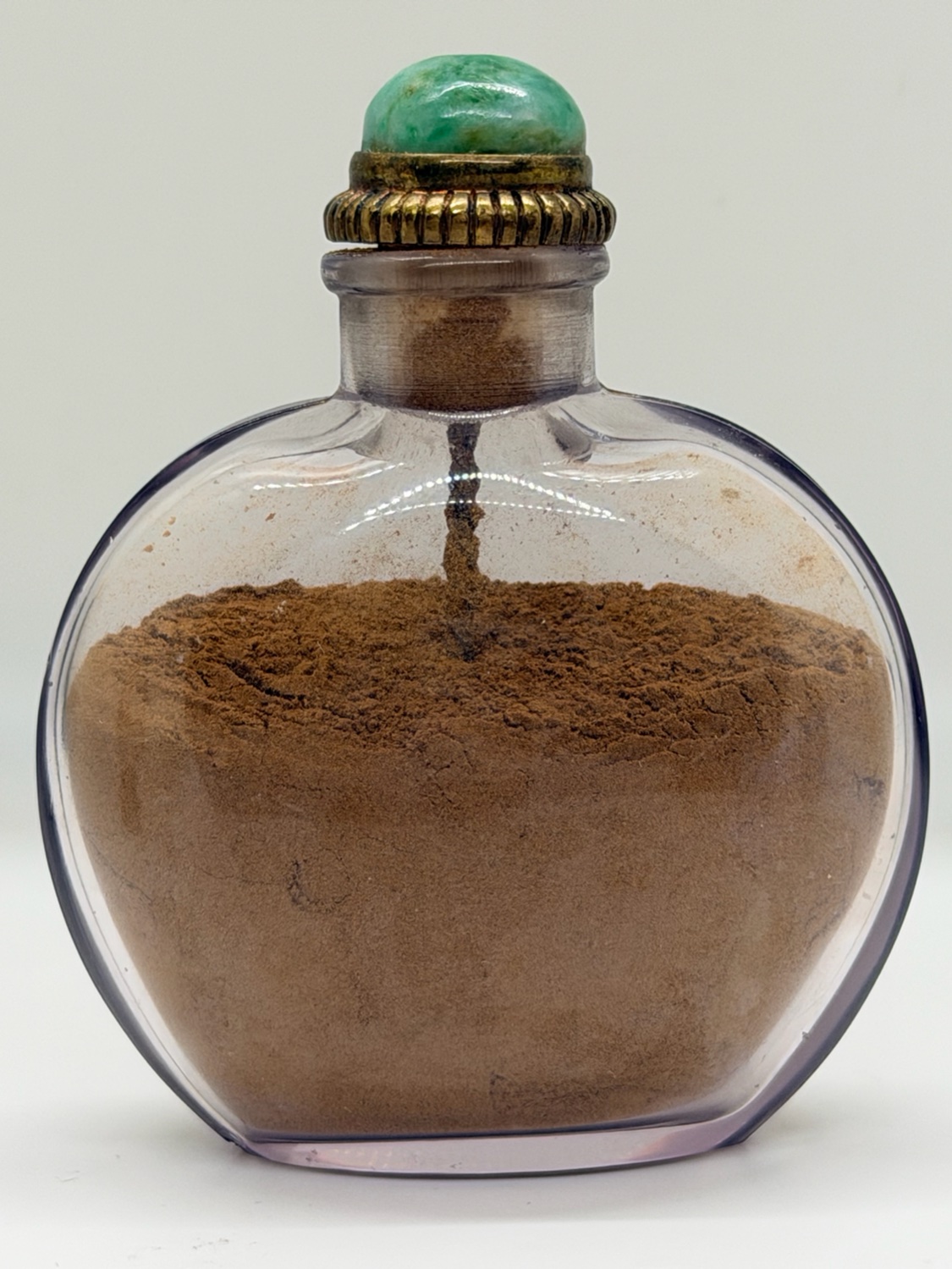
Plain and uncarved; the bottle still contains its snuff, the original spoon visible through the clear walls
Stopper
Green jadeite cabochon, gilt-metal ribbed collar
Height
2.3 in (58 mm), not including stopper
Condition
Minor chip
Provenance
Bonhams, Fine Chinese Snuff Bottles from Worldwide Collectors, San Francisco, 17 December 2018, lot 119 (Collection of Mr. Albert Chan Yue Hong); Te Feng Company, Hong Kong, 16 March 1997
Notes
Hollowing: Well hollowed. The bottle still contains its snuff, with the original spoon in place. Bonhams catalogued this bottle as 18th/19th century; it sold in San Francisco on 17 December 2018 as lot 119, from the collection of Mr. Albert Chan Yue Hong. Meaning: clear rock crystal is the emblem of purity and clarity; the flattened round body is shaped like the full moon — completeness and reunion — and a plain crystal bottle takes its beauty from the light passing through the stone itself. Bonhams catalogued the bottle simply as 'A rock crystal snuff bottle, 18th/19th century' (lot 119); rock crystal was a strength of the Albert Chan Yue Hong collection — the following lot, 120, was a pair of 19th-century rock crystal bottles including an Imperial Daoguang double bottle.

A rock crystal snuff bottle of flattened circular form, 18th/19th century. The body is plain and uncarved, polished clear as water, and still contains its snuff, the original spoon visible through the walls — a survival that is itself uncommon, since bottles were normally emptied and cleaned in use. With nothing carved on it, a bottle of this type stands or falls on the quality of the crystal and of the hollowing: the stone here is bright and even, the flattened circular body well hollowed, its thin walls throwing the light straight through. The stopper is a green jadeite cabochon in a gilt-metal ribbed collar. Provenance: Bonhams, Fine Chinese Snuff Bottles from Worldwide Collectors, San Francisco, 17 December 2018, lot 119, from the collection of Mr. Albert Chan Yue Hong; Te Feng Company, Hong Kong, 16 March 1997. Clear crystal stands for purity and clarity, and the flattened round body is the full moon — completeness and reunion; a plain crystal bottle takes its beauty from light itself. The bottle rests on a flat oval foot, polished smooth, with a small nick at the footrim.


中文說明

十八至十九世紀,水晶鼻煙壺,扁身,素面無紋,壺身清澈如水,內仍存鼻煙,原匙尚在,隔壁可見——鼻煙壺歷經使用而原煙與原匙俱存者,並不多見。素面之壺無紋飾可憑,全憑水晶質地與掏膛功夫見長短:此壺晶質明淨均勻,扁圓之身掏膛良好,壁薄透光。蓋為翡翠蛋面,配鎏金屬棱紋圈。來源:邦瀚斯2018年12月17日三藩市拍賣(Fine Chinese Snuff Bottles from Worldwide Collectors),拍品119號,Albert Chan Yue Hong藏品;德豐公司,香港,1997年3月16日。水晶象徵純潔清澈,扁圓之身如滿月,寓意圓滿團圓;素面水晶之美,在於光影本身。壺底為平削橢圓足,磨光平整,足邊有一小磕。

No. 19

Chinese Famille Rose Porcelain Snuff Bottle with Two Dragons over Waves

粉彩雙龍海水紋瓷鼻煙壺

Category
Porcelain 瓷器 · Famille rose 粉彩
Material
Porcelain
Period
Qing dynasty, Daoguang period (1821–1850)
Form
Flattened ovoid form, cylindrical neck, oval foot
Decoration
Famille rose enamels over an incised wave ground: a yellow-scaled five-clawed dragon on the front and a green five-clawed dragon on the back, iron-red flames at the sides; the recessed base painted inside with an iron-red dragon and inked with the collection number 'M.41'. Photographed on a wooden stand (not part of the bottle)
Stopper
Coral-red dome, green collar
Height
2.5 in (64 mm), not including stopper
Condition
Good
Notes
Hollowing: Good hollowed. The base is painted inside the foot with an iron-red dragon and bears the inked number 'M.41', apparently an earlier collection's inventory mark. Meaning: two dragons over the waves — the dragon commands wind and rain and rises from the sea in power; yellow and green dragons face to face across the bottle, a wish for strength, rank and good fortune; the endless incised waves beneath them are the sea from which the dragon ascends. The dragon-over-incised-waves scheme is a Jiaqing–Daoguang Jingdezhen type; compare the Jiaqing-marked example at Sotheby's (lot 176, 2011) and the moulded Daoguang-marked Imperial-kiln bottles at Bonhams Hong Kong (28 November 2011, lot 2, Treasury 6, no. 1336; 24 November 2012, lot 79). This bottle is the painted, unmarked variant, its foot painted inside with an iron-red dragon.

A famille rose porcelain snuff bottle, Qing dynasty, Daoguang period (1821–1850). Over a ground of finely incised waves, a yellow-scaled five-clawed dragon coils across the front and a green five-clawed dragon across the back, with iron-red flames at the sides; inside the recessed oval foot is an iron-red dragon, and the base is inked 'M.41', apparently an earlier collection's inventory number. The stopper is a coral-red dome with a green collar. The bottle is photographed on a wooden stand. Dragons enamelled over an incised wave ground are a Jingdezhen type of the Jiaqing and Daoguang periods: Sotheby's has catalogued a Jiaqing-marked example painted with dragons above foaming waves, and Bonhams the moulded Daoguang-marked Imperial versions of the dragon bottle (Hong Kong, 28 November 2011, lot 2, published in A Treasury of Chinese Snuff Bottles, vol. 6, no. 1336; and 24 November 2012, lot 79). This bottle is painted rather than moulded and carries no reign mark — in place of a mark, its foot holds the hidden iron-red dragon and the 'M.41' number of a later collection. The dragon rising from the sea is an emblem of power, rank and good fortune, and the two dragons — yellow and green — turn the bottle in the hand like the dragon turning in the waves.


中文說明

清代道光時期(1821–1850),粉彩瓷鼻煙壺,扁圓身,直頸,橢圓足。壺身以暗刻海水紋為地,正面繪黃鱗五爪龍,背面繪綠鱗五爪龍,兩側配鐵紅火焰紋;足內凹底繪鐵紅龍紋,並墨書「M.41」編號,似為舊藏家之藏品編號。蓋為珊瑚紅配綠圈。海水地繪龍紋為嘉慶、道光兩朝景德鎮瓷煙壺之一格:蘇富比曾著錄嘉慶款同類作品,龍紋騰躍於波濤之上;邦瀚斯則著錄道光款模製龍紋壺之御窯本(2011年11月28日香港拍賣,拍品2號,收入《中國鼻煙壺珍賞》第六冊第1336號;2012年11月24日拍品79號)。此壺為彩繪而非模製,亦無年款,足內以暗藏之鐵紅龍紋與後來藏家之「M.41」編號代之,別具趣味。龍出滄海,象徵權勢、尊貴與吉祥;黃、綠雙龍隔壺相對,持壺轉動,如龍行波濤之間。

No. 20

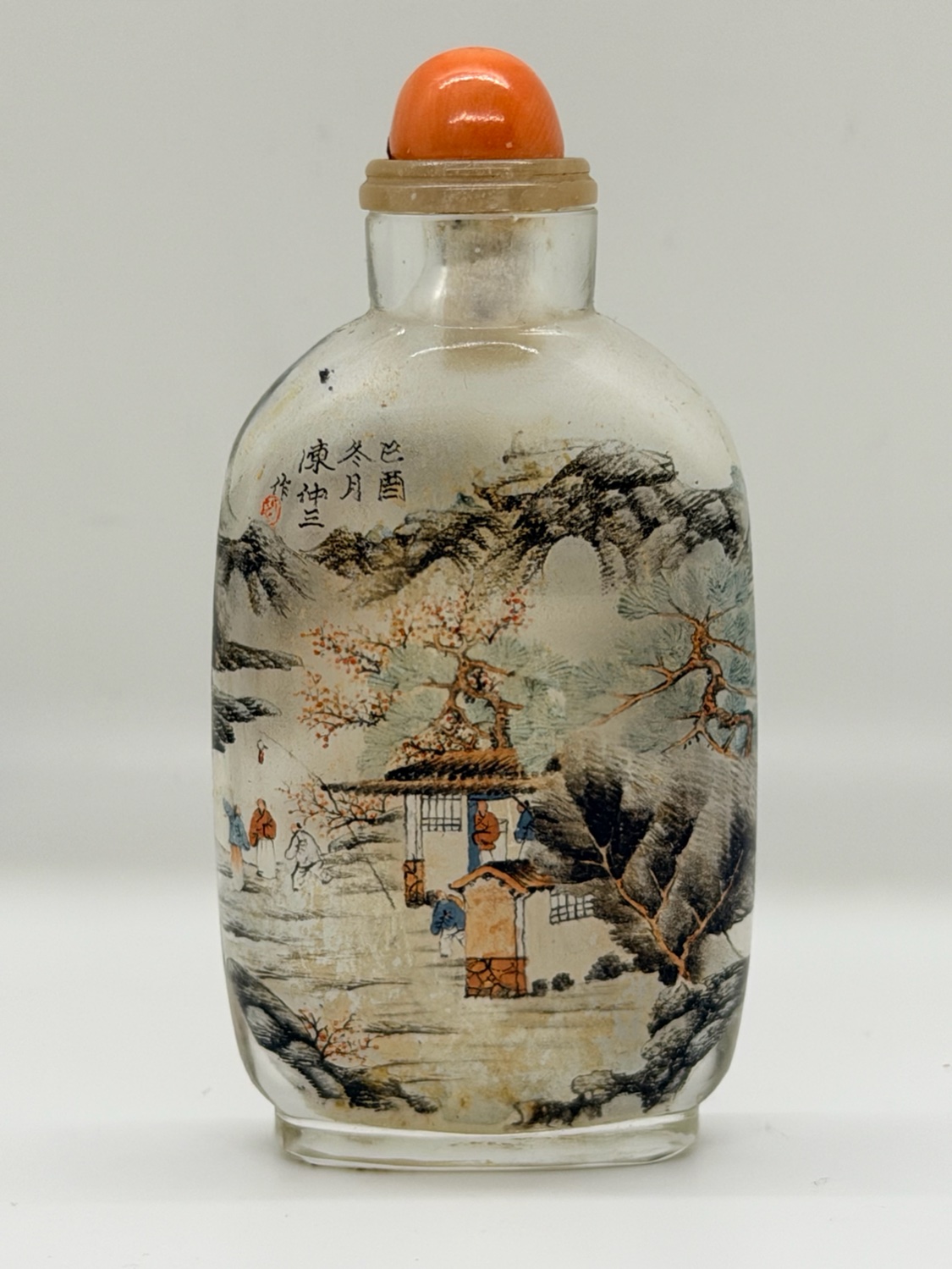
Chinese Inside-Painted Glass Snuff Bottle with Landscape and Figures, Signed Chen Zhongsan

玻璃內畫山水人物鼻煙壺陳仲三款

Category
Glass 玻璃 · Inside-painted 內畫
Material
Glass
Period
Dated jiyou (1909)
Form
Flattened rounded rectangular form, cylindrical neck, flat oval foot
Decoration
Inside-painted continuous landscape: one face with a pavilion among pines and craggy mountains and figures on the path; the other with a river, a boat, a distant pagoda and pavilion, and figures on the bank; inscription and artist's seal on the first face
Stopper
Coral-red dome, beige collar
Height
2.5 in (64 mm), not including stopper
Condition
Good
Notes
Inscription: 己酉冬月陳仲三作 ('Painted by Chen Zhongsan in the winter month of the jiyou year, 1909'), with the artist's seal. Chen Zhongsan was a late arrival to the Beijing school of inside painting: his dated works span 1907 to 1919, about sixty bottles survive, three-quarters of them dated, and he painted almost exclusively in glass; he is renowned for filling his compositions with endless detail. Meaning: a scholar's landscape — the pavilion in the pines, travellers on the path and a boat on the river paint the literati ideal of retreat into nature, far from the dust of the world. Dated 1909, this is an early work within Chen Zhongsan's short dated career (1907–1919); two other jiyou (1909) bottles by him are recorded at Bonhams New York — lot 105, 9 September 2019 (Bob Stevens Collection), and lot 451, 21 September 2021 (Manfred Arnold Collection).

An inside-painted glass snuff bottle signed Chen Zhongsan, dated to the winter month of the jiyou year (1909). One face shows a pavilion among pine trees and craggy mountains, with figures on the path; the other continues the landscape across a river — a boat mid-stream, a pagoda and pavilion in the distance, figures on the bank — so that the painting runs unbroken around the bottle, a handscroll in miniature to be turned in the hand. The stopper is a coral-red dome with a beige collar. Chen Zhongsan was a late arrival to the Beijing school of inside painting: his dated works span 1907 to 1919, some sixty bottles survive, most of them dated and nearly all in glass, and he is renowned for filling his compositions with endless detail — as here, where every bank, roof and figure is separately drawn. A 1909 date places this bottle early in that short career: Bonhams, cataloguing another Chen Zhongsan bottle of the same jiyou year (New York, 21 September 2021, lot 451), notes that his dated bottles span little more than the decade 1907–1919, "making this an early bottle in his oeuvre," and a second 1909 example, painted with Meng Haoran seeking plum blossom, was sold by Bonhams from the Bob Stevens Collection (New York, 9 September 2019, lot 105). The subject is a scholar's retreat in the mountains, carried in the palm.


中文說明

玻璃內畫鼻煙壺,己酉年(1909)冬月陳仲三作。壺身通景山水:一面繪松山茅舍,行人沿徑而行;另一面江水橫陳,舟行江中,遠處寶塔樓閣,岸邊人物活動——畫面環壺相連,如掌中手卷,須轉壺方能盡覽。蓋為珊瑚紅配米色圈。陳仲三為京派內畫後起之秀,有紀年作品存世於1907至1919年間,傳世約六十件,大多有紀年,且幾乎全為玻璃胎,以構圖繁密、細節豐富著稱。此壺作於己酉(1909),正當其創作生涯之早年:邦瀚斯著錄另一件同為己酉年作之陳仲三鼻煙壺(2021年9月21日紐約拍賣,拍品451號)時即指出,其有紀年之作僅1907至1919年十餘年間,此乃其早期手筆;又邦瀚斯2019年9月9日紐約拍賣拍品105號,亦為1909年作,出自 Bob Stevens 藏品。此壺寫文人山居之志——避世林泉,寄情山水。

No. 21

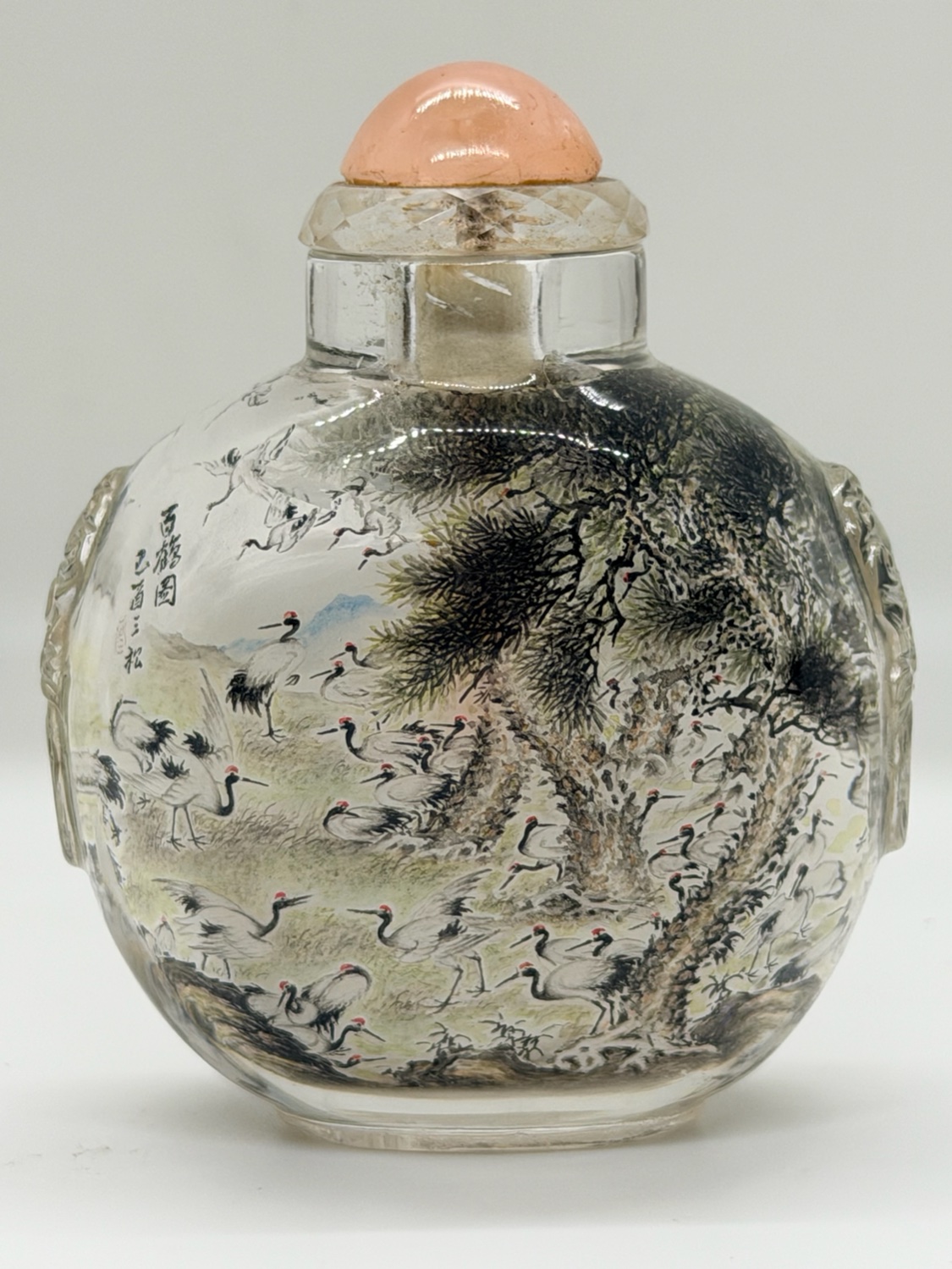
Chinese Inside-Painted Man-Made Crystal Snuff Bottle with One Hundred Cranes, Signed Sansong

人造水晶內畫百鶴圖鼻煙壺三松款

Category
Crystal & Quartz 水晶 · Inside-painted 內畫
Material
Man-made crystal
Period
Dated yiyou (2005)
Form
Flattened circular form with carved mask-and-ring handles, cylindrical neck, oval foot
Decoration
Inside-painted continuous scene of one hundred cranes beneath a pine tree, inscribed 'Hundred Cranes' (百鶴圖), dated yiyou and signed Sansong (三松) with a seal
Stopper
Pink dome stopper, faceted crystal collar
Height
2.2 in (56 mm), not including stopper
Condition
Good
Notes
Inscription: 百鶴圖,乙酉三松 ('Picture of a Hundred Cranes; yiyou year; Sansong'), with the artist's seal. The signature 三松 is Sun Jianguo (孫建國, born 1963), art name Sun Sansong (孫三松), a contemporary master of the Ji school of inside painting. Meaning: the crane is the bird of longevity, and cranes beneath a pine make the classic wish 松鶴延年 — 'may you live as long as the pine and the crane'; a hundred cranes multiply the wish a hundredfold. Bonhams records the artist under his art name: an inside-painted 'Cats' bottle inscribed 孫三松作 was sold at Bonhams Sydney, 3 May 2016, lot 36 (Franca Arena Collection).

An inside-painted man-made crystal snuff bottle, signed Sansong and dated to the yiyou year (2005). Around the flattened circular body, carved with mask-and-ring handles at the sides, a hundred cranes gather beneath an old pine — standing, preening, taking flight — in one continuous scene; the stopper is a pink dome with a faceted crystal collar. Man-made crystal is the Ji school's characteristic blank: flawless and water-clear, it gives the painter an even, unclouded wall on which a crowd scene of this density can be built up feather by feather. Crane compositions have a long inside-painting pedigree — the Ye family of the Beijing school painted cranes beneath a pine as early as the 1930s — but the full hundred is a modern master's set piece, the auspicious number carried to its limit. The signature Sansong (三松) is Sun Jianguo (born 1963), art name Sun Sansong, a contemporary master of the Ji school — the Hebei school of inside painting centred on Hengshui, one of the leading schools of the modern art; Bonhams catalogues him under this same art name, for example an inside-painted 'Cats' bottle inscribed 孫三松作 (Sydney, 3 May 2016, lot 36). The crane is the bird of longevity, and cranes beneath a pine form the classic wish song he yan nian (松鶴延年): a long life, steadfast as the pine and enduring as the crane — here multiplied a hundredfold.


中文說明

人造水晶內畫鼻煙壺,乙酉年(2005)三松作。壺身扁圓,兩側雕獸面銜環耳;內畫通景百鶴圖:古松之下,百鶴或立或翔,姿態各異。人造水晶為冀派內畫常用之胎料,質地純淨透澈、無瑕無翳,正宜施展此種羽片層疊、繁密滿幅的通景構圖。蓋為粉紅色配刻面水晶圈。松下群鶴本為內畫傳統題材,京派葉家早於二十世紀三十年代已有松鶴之作;集至百鶴,則是當代名家炫技之大題材,取其數滿百之吉。三松即孫建國(1963年生),藝名孫三松,當代冀派內畫大師——冀派以河北衡水為中心,為現代內畫重要流派;邦瀚斯著錄其作品,亦以「孫三松作」款識為憑(如2016年5月3日悉尼拍賣拍品36號內畫「貍奴」壺)。鶴為長壽之鳥,松鶴同圖即「松鶴延年」之祝,百鶴齊集,福壽綿長之意更增百倍。

No. 22

Chinese Inside-Painted Glass Snuff Bottle with Scholar, Boy and Bamboo, Signed Sun Xingwu

玻璃內畫耕讀圖鼻煙壺孫星五款

Category
Glass 玻璃 · Inside-painted 內畫
Material
Glass
Period
Dated yiwei (1895)
Form
Flattened rounded form, cylindrical neck, flat oval foot
Decoration
Inside-painted: front — an old man and a boy planting bamboo beside a house, a scholar reading at the window within, inscribed with a couplet and 'Painted in the capital' with two seals; reverse — the full text of Han Hong's poem 'Cold Food' in fine calligraphy, dated yiwei, winter month, written at the south window of the Yunxiang Studio, signed Sun Xingwu
Stopper
Pink dome stopper, black collar
Height
2.5 in (64 mm), not including stopper
Condition
Good
Notes
Inscriptions — front: 貧不賣書留子讀,老猶栽竹與人看 ('Poor, yet never sell your books — keep them for your sons to read; old, yet still plant bamboo for others to enjoy'), 寫於京師 ('Painted in the capital'), with two seals. The couplet is a household maxim preserved in the Zengguang Xianwen. Reverse: the full text of Han Hong's (Tang dynasty) poem 'Cold Food' (寒食): 春城無處不飛花,寒食東風御柳斜,日暮漢宮傳蠟燭,青煙散入五侯家; dated 'winter month of the yiwei year' (1895), 'written at the south window of the Yunxiang Studio' (芸香書屋之南窗下), signed Sun Xingwu. Artist: Sun Xingwu, celebrated Beijing-school master of the late Qing and early Republic, ranked alongside Ma Shaoxuan and Ye Zhongsan, excelling in landscape, figures and inside-painted calligraphy; 'Yunxiang Studio' (芸香書屋) was his studio name; dated works 1894–1900 only, about 65 bottles recorded. Meaning: the farming-and-study family ideal (耕讀傳家) — books kept for one's sons, bamboo planted for others; bamboo, hollow-hearted, stands for the gentleman's humility and integrity. Note: on the bottle, the fourth character of the poem's third column is written 青 ('blue') — the painter's slip for the poem's original 輕 ('light'). The poem is a veiled satire: on Cold Food Day, when all fires were banned, only the palace and the Five Lords' houses received imperial candles. A second Sun Xingwu bottle of this same year, dated mid-autumn 1895 and likewise inscribed with a couplet and two seals, is published in A Treasury of Chinese Snuff Bottles, vol. 4, no. 565 (Bonhams, Hong Kong, 27 May 2012, lot 113).

An inside-painted glass snuff bottle signed by Sun Xingwu and dated to the winter month of the yiwei year (1895). The front paints the very couplet inscribed beside it — 'Poor, yet never sell your books: keep them for your sons to read; old, yet still plant bamboo for others to enjoy': an old man and a boy set out bamboo beside a house while a scholar reads at the window within, with the words 'Painted in the capital' and two seals. The reverse is given wholly to calligraphy — the full text of the Tang poet Han Hong's 'Cold Food Day': 'All over the spring city, blossoms fly…' — closing 'written in the winter month of the yiwei year at the south window of the Yunxiang Studio, Sun Xingwu.' To fill one whole face of a bottle with nothing but writing is the boldest thing an inside painter can do: there is no picture to hide behind, and the calligraphy must stand as painting. Sun Xingwu was a celebrated master of the Beijing school of inside painting in the late Qing and early Republic, ranked alongside Ma Shaoxuan and Ye Zhongsan; he excelled in landscape, figure subjects and inside-painted calligraphy, and 'Yunxiang Studio' was his studio name. His dated works survive only from 1894 to 1900, and some sixty-five bottles are recorded, several illustrated in A Treasury of Chinese Snuff Bottles, vol. 4; another bottle of this same year, 1895, inscribed with a couplet and two seals, is published there as no. 565 (Bonhams, Hong Kong, 27 May 2012, lot 113). The couplet, preserved in the Zengguang Xianwen, is the creed of the farming-and-study family: books handed down to sons, bamboo planted for others — learning and generosity as the true inheritance. The poem itself paints Chang'an on the Cold Food Festival — blossoms flying all over the city, the spring wind stirring the palace willows — then turns: on the day when every fire was banned, only the palace and the houses of the Five Lords received the gift of candles, their smoke curling upward — a veiled satire on the favoured eunuchs and overweening nobles of the day.


中文說明

玻璃內畫鼻煙壺,孫星五作,清光緒乙未年(1895)冬月。正面畫耕讀圖:老翁與童子於屋旁栽竹,屋內士人臨窗讀書,旁題「貧不賣書留子讀,老猶栽竹與人看」聯語及「寫於京師」,鈐印二方。背面全幅書唐人韓翃《寒食》詩:「春城無處不飛花,寒食東風御柳斜。日暮漢宮傳蠟燭,輕煙散入五侯家。」落款「時歲次乙未冬月寫於芸香書屋之南窗下,孫星五」。以整幅壺面專作書法、別無圖畫,是內畫中最見膽識的一格——無景可託,筆墨須自成畫意。孫星五為清末民初京派內畫名家,與馬少宣、葉仲三齊名,擅長山水、人物及內畫書法;「芸香書屋」為其書齋號。其有紀年之作僅見於1894至1900年間,傳世約六十五件,《中國鼻煙壺珍賞》第四冊著錄數件;同為乙未(1895)年作、題聯鈐雙印之另一件,即該書第565號(邦瀚斯2012年5月27日香港拍賣,拍品113號)。聯語出自《增廣賢文》,乃耕讀傳家之家訓:留書於子,栽竹於人,學問與仁厚方為傳家之寶。按:壺上第三行第四字作「青」煙,乃書寫者筆誤,原詩為「輕」煙。詩意:此詩寫長安寒食節景象——前半寫滿城飛花、春風拂御柳;後半筆鋒一轉,寒食本應禁火,唯皇宮與五侯之家獲賜蠟燭、煙氣裊裊,委婉諷刺當時宦官得寵、權貴專橫。

No. 23

Chinese Carved Ivory Snuff Bottle with the Eighteen Luohans

牙雕十八羅漢鼻煙壺

Category
Organic & Other 有機及其他 · Ivory 牙雕
Material
Ivory
Period
Late 19th–early 20th century
Form
Large flattened ovoid form carved all over in high relief, oval foot
Decoration
Carved in high relief all around with the Eighteen Luohans — among them the lion-taming and dragon-subduing luohans — over a wave-pattern ground; the base with a red-filled Qianlong seal mark (apocryphal)
Stopper
Matching carved ivory stopper with lotus-petal dome and orange-red cabochon finial
Height
2.8 in (71 mm), not including stopper
Condition
Good
Notes
Good hollowed. Base: oval foot with a red-filled two-character Qianlong (乾隆) seal mark, apocryphal. Photographed on a wooden stand (not part of the bottle). Meaning: the Eighteen Luohans are the Buddha's enlightened disciples and guardians of his teaching; the full company carved on a single bottle is a complete blessing — protection on every side — and the lion-taming and dragon-subduing luohans stand for mastery over the wild forces of the world. The eighteen-luohan subject in ivory is rare; compare the ivory 'eighteen luohan' snuff bottle in the Paul Braga Collection (Bonhams, Hong Kong, 24 November 2012, lot 130) and the example in the Fitzwilliam Museum, Cambridge (O.17 & A-1961), dated 1820–1900, with matching stopper.

A large carved ivory snuff bottle, late 19th to early 20th century. The whole body is carved in high relief with the Eighteen Luohans — laughing, preaching, reading, one taming a lion, another subduing a dragon — packed shoulder to shoulder over a wave-pattern ground, with a matching carved ivory stopper whose lotus-petal dome is topped by an orange-red cabochon. The oval base carries a red-filled Qianlong seal mark, an apocryphal tribute to the great age of imperial carving. Carving the full company of eighteen figures, each with his own expression, attribute and familiar animal, onto a bottle under three inches is a carver's showpiece of the kind the Canton ivory workshops produced in the late Qing; the subject in ivory is correspondingly uncommon — Bonhams' Paul Braga Collection included an ivory 'eighteen luohan' snuff bottle of the Qing dynasty (Hong Kong, 24 November 2012, lot 130), and the Fitzwilliam Museum, Cambridge, holds another, dated 1820–1900, its stopper matching and original. The Eighteen Luohans are the Buddha's enlightened disciples and guardians of his teaching; the full company on one bottle is a complete blessing — protection on every side.


中文說明

牙雕鼻煙壺,清末至二十世紀初。通體高浮雕十八羅漢:或笑或誦,或降獅,或伏龍,布滿壺身,底襯波紋地;配原裝牙雕蓋,蓋面刻蓮瓣,頂嵌橙紅色圓珠。壺底橢圓足內刻紅填「乾隆」篆印,為仿古托款。十八羅漢各具神態、持物與坐騎,悉數刻於三寸不到的壺身之上,是清末廣州牙雕作坊炫技之作;此題材以象牙製壺者並不多見——邦瀚斯2012年11月24日香港 Paul Braga 藏品專場中有一件清代牙雕十八羅漢鼻煙壺(拍品130號),劍橋菲茨威廉博物館亦藏一件同題材作品(約1820至1900年),配原裝壺蓋。十八羅漢乃佛陀得道弟子、護法尊者,全數畢集一壺,寓意護佑周全、福澤綿長。

No. 24

Chinese Banded Agate Snuff Bottle with Incised Goose and Snowbank

纏絲瑪瑙線刻雪雁鼻煙壺

Category
Agate & Chalcedony 瑪瑙 · Banded agate 纏絲瑪瑙
Material
Banded agate (chalcedony)
Period
Qing dynasty, 19th century
Form
Flattened rounded form, cylindrical neck, flat oval foot
Decoration
The front finely incised with a goose standing in grass below a white band in the stone, flowering plants above — the carver using the natural white band as a snowbank; the reverse plain, showing the honey-brown banding
Stopper
Green speckled dome stopper
Height
2 in (51 mm), not including stopper
Condition
Chip
Notes
Well hollowed. In the Suzhou manner of fine incised carving associated with the Zhiting school. Meaning: the picture is made by the stone itself — qiaose, the 'clever use of colour': the white band becomes a snowbank. The wild goose stands for fidelity and for letters from afar; a goose in the snow adds purity and quiet endurance. Christie's notes that ducks and geese are a favourite subject on silhouette agate snuff bottles (A Treasury of Chinese Snuff Bottles, vol. 2, nos. 272–277); a pictorial agate of the same 2 in. height pairing a goose with incised work was catalogued by Christie's as Official School, 1780–1860 (lot 4566346).

A banded agate snuff bottle, Qing dynasty, 19th century, in the Suzhou manner of fine incised carving associated with the Zhiting school. The stone is a warm honey-brown chalcedony crossed by a single white band; on the front the carver has drawn with a few incised lines — a goose standing in the grass below the band, flowering plants above — turning the white band itself into a snowbank, the classic qiaose, or 'clever use of colour', of the Suzhou workshops. The reverse is left plain, the banding unadorned. Where the Zhiting school's celebrated bottles carve their pictures out of the stone's coloured inclusions in relief, this bottle does the opposite and the harder thing: it barely touches the stone, a handful of incised lines persuading the eye that the stripe of white agate is a bank of snow. Christie's, cataloguing a Zhiting-school agate bottle with a goose, notes that ducks and geese are a favourite subject on silhouette agate bottles (see A Treasury of Chinese Snuff Bottles, vol. 2, nos. 272–277) and describes the school's genius as making the artist seem "not constrained in any way by the material" — here the constraint of a single band becomes the whole picture. The wild goose is an emblem of fidelity and of letters from afar; a goose in the snow adds purity and quiet endurance — a whole winter landscape conjured from one stripe in the stone.


中文說明

纏絲瑪瑙鼻煙壺,清代十九世紀,蘇作陰刻一路,近芝亭派風格。瑪瑙呈蜜糖色,一道白紋橫貫壺身;正面以疏朗線刻勾勒雪雁:白紋之下,雁立草間;白紋之上,花枝舒展——匠人巧借石中白紋為雪,此即蘇州玉工之「巧色」。背面素面,任紋理自呈。芝亭派名作多以俏色浮雕取勝,此壺反其道而行,落刀極省,僅以數道刻線點醒石紋,使白瑪瑙化作雪岸,是更見功力的一路。佳士得著錄芝亭派瑪瑙壺時曾指出,鴨、雁本為剪影瑪瑙(silhouette agate)壺之常見題材(參《中國鼻煙壺珍賞》第二冊第272至277號),並稱此派之妙,在於匠人運用石中色紋渾然天成,彷彿全不受材料拘束——此壺正以一紋成景,深得其旨。雁主信守與遠信,雪中之雁更添高潔堅忍之意;方寸小壺,一段石紋,已成寒江雪景。

No. 25

Chinese Inside-Painted Glass Snuff Bottle with Carp and Goldfish, Signed Ye Zhongsan

玻璃內畫魚藻圖鼻煙壺葉仲三款

Category
Glass 玻璃 · Inside-painted 內畫
Material
Glass
Period
Dated yimao (1915)
Form
Flattened rounded rectangular form, cylindrical neck, flat oval foot
Decoration
Inside-painted continuous pond scene: carp and goldfish among pondweed on both faces, inscribed, dated yimao and signed Ye Zhongsan with a seal
Stopper
Coral-red dome stopper, dark blue collar
Height
2.3 in (58 mm), not including stopper
Condition
Good
Notes
Inscription: dated yimao (1915), signed Ye Zhongsan (葉仲三作), with the artist's seal. Artist: Ye Zhongsan (1875–1940), founding master of the Beijing school of inside painting. Meaning: the carp stands for abundance and perseverance — the carp that leaps the Dragon Gate is transformed into a dragon; the goldfish puns on 'gold and jade' (金玉); fish among pondweed promise plenty year after year (連年有餘). Dated parallels from the same years: a glass bottle by Ye Zhongsan dated yimao (1915) sold at Bonhams, London, 11 May 2015, lot 514; a glass carp-and-goldfish bottle dated jiazi (1914) offered by Christie's; an inside-painted agate fish bottle dated 1915 sold at Bonhams, New York, 13 March 2017, lot 1102.

An inside-painted glass snuff bottle signed by Ye Zhongsan and dated to the yimao year (1915). The flattened rounded rectangular body is painted from within, through the narrow mouth, with a continuous pond scene that flows unbroken around both faces: great carp in ink-grey and goldfish in vermilion drift and turn among feathery pondweed, the fish painted with the flickering, sketch-like brushwork — scales, fins and trailing weeds suggested in a few strokes — for which Ye's aquatic subjects were prized. The inscription, date and the artist's seal complete the composition. Fish were a signature subject of the artist: as Bonhams has noted of his work, goldfish in a pond setting was one of Ye Zhongsan's favourite themes, and the pairing of goldfish with a carp is among the less common variants. Dated fish bottles from these same years are recorded in glass, agate and rock crystal — a glass example dated jiazi (1914) with carp and goldfish among water weed was offered by Christie's, an inside-painted glass bottle dated to this same yimao year of 1915 was sold by Bonhams in London, and a 1915 agate bottle painted with a continuous scene of fish among water weeds was sold by Bonhams in New York. Ye Zhongsan (1875–1940) was the founding master of the Beijing school of inside painting: self-taught in the art, he founded the Ye family school and trained his sons and a generation of painters; fish were among his favourite subjects. The carp stands for abundance and for perseverance — the carp that leaps the Dragon Gate is transformed; the goldfish puns on 'gold and jade'; fish among the weeds promise plenty year after year. Coral-red dome stopper with a dark blue collar.


中文說明

玻璃內畫鼻煙壺,葉仲三作,乙卯年(1915)。壺身扁圓長方形,畫家以特製勾毛筆自壺口探入,於內壁反畫通景魚藻圖,兩面連綿相接:灰鯉體碩、紅金魚靈動,穿梭於輕柔水草之間,鱗鰭搖曳,筆法寫意生動,正是葉派魚藻題材最見功力之處。壺上有題識、紀年及畫家印章。魚藻為葉仲三最擅長之題材——拍賣行論其作品時亦指出,金魚戲水為葉氏最喜愛之主題之一,而金魚與鯉魚同池則較為少見。與此壺相近年份之魚藻壺存世有玻璃、瑪瑙、水晶諸品:佳士得曾拍一件甲子年(1914)玻璃內畫鯉魚金魚壺,邦瀚斯倫敦曾拍一件同為乙卯年(1915)之玻璃內畫壺,邦瀚斯紐約亦曾拍一件1915年瑪瑙內畫連年有餘紋壺,皆可互參。葉仲三(1875–1940)為京派內畫創始人,自學成家,創立葉派,子侄門人輩出,為一代宗師;魚藻為其擅長題材。鯉主豐餘與堅毅——鯉躍龍門,化而為龍;金魚諧音「金玉」,魚藻之間,寓意連年有餘、金玉滿堂。配珊瑚紅圓頂蓋、深藍蓋座。

No. 26

Chinese Blue-and-White Porcelain Snuff Bottle with Groom and Horses

青花牧馬圖瓷鼻煙壺

Category
Porcelain 瓷器 · Blue and white 青花
Material
Porcelain, underglaze blue
Period
Qing dynasty, 19th century
Form
Tall cylindrical form, short cylindrical neck, flat base
Decoration
Painted in underglaze blue with a continuous scene of a groom tending his horses — one horse dappled — among pine branches and rockwork, wrapping the body
Stopper
Metal stopper with a small red cabochon
Height
3.2 in (81 mm), not including stopper
Condition
Good
Notes
Meaning: the horse is an emblem of vigour and swift success — 'on horseback' (馬上) puns on 'immediately', promising advancement without delay; a groom with fine horses recalls the celebrated steeds of King Mu of Zhou. Base mark: underglaze-blue six-character Daqing Yongzheng nianzhi mark (apocryphal). Comparables: Doyle, New York, tall cylindrical blue-and-white bottle painted in the round, six-character Yongzheng mark (sold $1,375); Bonhams, New York, 16 September 2013, lot 8040, late Qing cylindrical bottle with six-character Yongzheng mark on the recessed foot (sold US$5,625); Bonhams, London, 3 November 2014, lot 51, cylindrical bottle painted with a horse-rider, base with an apocryphal Yongzheng six-character mark.

A blue-and-white porcelain snuff bottle, Qing dynasty, 19th century. At 3.2 in (81 mm) this is a tall bottle, its straight cylindrical body — the classic form for porcelain snuff bottles of the period — painted in underglaze blue with one continuous scene that wraps the body without a break: a groom leading and tending his horses — one of them handsomely dappled — among pine branches and rockwork, the animals distributed around the cylinder so that the scene unfolds as the bottle is turned in the hand. Cylindrical blue-and-white bottles of this height and type, painted in the round and marked on the base, recur in the salerooms: Doyle has sold a tall cylindrical example painted in the round with a six-character Yongzheng mark on the base, and Bonhams a late Qing cylindrical bottle of 3¼ in. with a six-character Yongzheng mark on its recessed foot. The horse is an emblem of vigour and swift success: 'on horseback' puns on 'immediately', so a horse promises advancement without delay; a groom with fine horses recalls the celebrated steeds of King Mu of Zhou. The flat base bears an underglaze-blue six-character mark, Daqing Yongzheng nianzhi ('Made in the Yongzheng reign of the Great Qing') — an apocryphal mark, as is common on 19th-century porcelain; Bonhams likewise catalogues comparable cylindrical bottles of circa 1900 as bearing an apocryphal Yongzheng six-character mark. Metal stopper with a small red cabochon.


中文說明

青花瓷鼻煙壺,清代十九世紀。壺高3.2英寸,為本藏中最高者之一;高直筒形乃清代瓷煙壺之經典器形。通景青花繪牧馬圖:馬伕牽馬、飼馬,駿馬或素或斑,松石相伴,畫面環繞壺身連綿不斷,須轉壺方能盡覽。此類高筒青花、通景繪畫、底帶款識之壺於拍場屢見:紐約Doyle曾拍一件高直筒青花壺,底署雍正六字款;邦瀚斯亦曾拍一件清末高筒青花壺,高3¼英寸,底署雍正六字款。馬為力量與成功之象;「馬上」諧音「即刻」,寓意升遷在即、馬到成功;牧馬名駒,亦令人想起周穆王八駿之典。壺底青花六字款「大清雍正年製」,乃寄託款,清代十九世紀瓷器常見,邦瀚斯對約1900年同類直筒壺亦明言其為寄託雍正六字款。配金屬蓋,嵌紅色小圓飾。

No. 27

Chinese Turquoise-Blue Glass Snuff Bottle with Pink Overlay Panels

藍套粉玻璃扁圓鼻煙壺

Category
Glass 玻璃 · Overlay glass 套玻璃
Material
Glass — opaque turquoise-blue with pink overlay
Period
Qing dynasty, 19th century
Form
Flattened circular form, faceted shoulders, cylindrical neck, oval foot
Decoration
Plain opaque turquoise-blue glass imitating turquoise, with pink overlay glass panels at the sides and a pink overlay foot rim
Stopper
Matching blue glass dome stopper, wide pink collar
Height
1.9 in (48 mm), not including stopper
Condition
Good
Provenance
Sotheby's, 1 December 2022; Collection of Gertrude Stuart; Collection of Hildegard Schonfeld, Christie's New York, 20 March 2013, lot 1103 (part lot); The Kardos Collection, Sotheby's New York, 1 July 1985, lot 68. Exhibited at the Vancouver Museum, 1977.
Notes
Good hollowed. Meaning: Qing glassmakers delighted in imitating precious stones — the blue wears the colour of turquoise, a stone of protection, and the pink that of tourmaline; the round, moon-like body speaks of completeness and reunion. The bottle's own sale history is documented at Christie's, New York, 20 March 2013, lot 1103 (part lot), where the pink overlay is described as forming the handles on the narrow sides and the oval foot rim, and at Sotheby's, New York, 1 December 2022. On the colour pairing, Sotheby's (Bloch Collection Part X, lot 125) notes that pink on turquoise-blue was the standard combination of a Qianlong-period palace glass group.

A glass snuff bottle, Qing dynasty, 19th century. The body is of opaque turquoise-blue glass, finished in imitation of turquoise, in a flattened circular form with faceted shoulders; at each side a panel of pink overlay glass, and the foot rim is wrapped in the same pink — a jewel-like pairing of colours. The stopper is a matching blue glass dome on a wide pink collar. The combination is a distinguished one: as Sotheby's has noted in cataloguing the Bloch Collection, pink on turquoise-blue was the standard colour combination of a group of palace glass carvings of the Qianlong period, and the pairing remained a favourite of Qing glassmakers. This is the plain, uncarved member of that family — its decoration is the colour itself — and it is unusually well documented. Christie's catalogued the bottle in the Hildegard Schonfeld Collection sale (New York, 20 March 2013, lot 1103, part lot), describing the pink overlay as forming the handles on the narrow sides and continuing over the oval foot rim, and Sotheby's offered it again on 1 December 2022. Qing glassmakers delighted in imitating precious stones, and this bottle wears the colours of turquoise and tourmaline at once; its round, moon-like body speaks of completeness and reunion. Provenance: Sotheby's, 1 December 2022; the Collection of Gertrude Stuart; the Collection of Hildegard Schonfeld (Christie's New York, 20 March 2013, lot 1103, part lot); the Kardos Collection (Sotheby's New York, 1 July 1985, lot 68). Exhibited at the Vancouver Museum, 1977.


中文說明

玻璃鼻煙壺,清代十九世紀。不透明松石藍色玻璃,仿綠松石之質,扁圓身,肩部起稜;兩側嵌粉紅色套料月片,足邊亦包粉紅套料。蓋為同色藍玻璃,配寬粉紅領。此藍粉配色來歷不凡:蘇富比拍賣柏煊珍藏時曾指出,粉套松石藍乃乾隆時期一組宮廷玻璃雕刻之標準配色,清代玻璃匠人沿用不衰。此壺為素面一品,不事雕琢,以色取勝,而流傳記錄尤為完整:佳士得於2013年紐約Hildegard Schonfeld珍藏專拍中著錄此壺(拍品1103號,部分拍品),述其粉紅套料於壺身兩側成耳、並環繞橢圓足邊;蘇富比2022年12月1日再度拍出。清代玻璃工匠善仿寶石,此壺一身兼綠松石之藍與碧璽之粉,色彩如寶;扁圓如滿月,寓意圓滿團圓。來源:蘇富比,2022年12月1日;Gertrude Stuart收藏;Hildegard Schonfeld收藏(紐約佳士得,2013年3月20日,拍品1103號,部分拍品);Kardos收藏(紐約蘇富比,1985年7月1日,拍品68號)。1977年於溫哥華博物館展出。

No. 28

Chinese White Nephrite Jade Snuff Bottle Carved with Rams and Horses

白玉雕三羊駿馬鼻煙壺

Category
Jade 玉石 · White nephrite 白玉
Material
White nephrite jade
Period
Late 18th–early 19th century
Form
Flattened ovoid form with recessed panels, cylindrical neck, oval foot
Decoration
Carved in low relief within recessed panels: front — three rams, one grazing, one standing with curved horns, one recumbent, beneath cloud scrolls and the sun; back — two horses beneath a pine tree, one grazing with a saddle cloth, one lying down
Stopper
Coral dome stopper, green collar and finial
Height
2.6 in (66 mm), not including stopper
Condition
Good
Provenance
Sotheby's, 2020
Notes
Good hollowed. Photographed on a carved wooden stand (not part of the bottle). Meaning: the three rams form the classic wish sanyang kaitai (三羊開泰) — 'the three rams bring prosperity' — yang, ram, echoing xiang, good fortune, a blessing for the New Year and for new beginnings; the horses on the reverse promise swift success — 'success upon the horse's arrival' (馬到成功) — and beneath the pine they gain the pine's endurance. The rams-and-horses pairing on white nephrite is paralleled by the Qianlong-marked bottle sold at Bonhams, Hong Kong, 27 May 2012, lot 236 (three rams on one side, a pair of horses under a tree on the other).

A white nephrite jade snuff bottle, late 18th–early 19th century. The flattened body is carved on both faces in low relief within recessed panels, the stone left plain and polished between them. On the front, three rams — one grazing, one standing with curved horns, one lying down — beneath cloud scrolls and the sun: the three rams of sanyang kaitai, 'the three rams bring prosperity', since yang, ram, echoes xiang, good fortune — a blessing for the New Year and for all new beginnings. On the back, two horses rest beneath a pine, one grazing with a saddle cloth on its back, one recumbent: horses promise swift success, success upon the horse's arrival, and beneath the pine they gain the pine's endurance. The pairing of the two subjects on a single white jade bottle has a distinguished precedent: Bonhams has catalogued a Qianlong-marked white nephrite bottle worked on one side with a flock of three rams and on the other with a pair of horses under a tree, noting the rarity of marked examples of the type, and the individual motifs recur across the salerooms — a white jade sanyang kaitai bottle with the three rams beneath the sun and wispy clouds at Bonhams in London, and a white jade bottle carved with two horses under a pine in the Joanna Lau Sullivan Trust sale at Bonhams in New York. The stopper is coral, with a green collar and finial. Provenance: Sotheby's, 2020.


中文說明

白玉鼻煙壺,十八世紀晚期至十九世紀早期。扁身,兩面開光淺浮雕,開光之外素面拋光,玉質溫潤。正面三羊:一低頭食草,一昂首而立、雙角彎曲,一臥地休憩,上有雲日——即「三羊開泰」,「羊」與「祥」通,寓意吉祥開泰、歲首納福、萬事開端順遂。背面雙馬憩於松樹之下:一馬披鞍低頭食草,一馬臥地——馬象徵馬到成功,松下之馬更添堅貞長久之意。三羊與雙馬同琢一壺,於名品有徵:邦瀚斯香港曾拍一件乾隆款白玉鼻煙壺,一面琢三羊、一面琢雙馬於樹下,與此壺題材正同,並指出白玉煙壺帶乾隆款者極為罕見;其單一題材亦屢見拍場——倫敦邦瀚斯有白玉三羊開泰壺,三羊在日下雲間;紐約邦瀚斯Joanna Lau Sullivan信託拍賣有白玉雙馬松下壺。蓋為珊瑚質,配綠領綠鈕。來源:蘇富比,2020年。

No. 29

Chinese Amber Snuff Bottle Carved with Three Rams and a Buddhist Deity

琥珀雕三羊佛像鼻煙壺

Category
Organic & Other 有機及其他 · Amber 琥珀
Material
Amber
Period
Qing dynasty, 19th century
Form
Flattened circular form, cylindrical neck, oval foot
Decoration
Carved in relief with three rams beneath cloud scrolls on one face, and a multi-armed Buddhist deity (a form of Avalokiteshvara) seated on a lotus on the reverse
Stopper
Coral-red dome stopper with green collar
Height
2.3 in (58 mm), not including stopper
Condition
Minor chips
Provenance
Fine Chinese Snuff Bottles from the Gerry P. Mack Collection, Christie's South Kensington, 4 October 1999, sale 8552, lot 146; Property from the Collection of David Billings and Beverly Hall Billings, Nantucket, Massachusetts.
Notes
Hollowing: Good hollowed. The three rams are the sanyang kaitai (三羊開泰) motif — yang (ram) echoes xiang (auspiciousness), and kaitai means the opening of good fortune: a wish for prosperity and smooth beginnings. The multi-armed deity on the reverse embodies compassion and protection, and amber itself — fossilised pine resin, once called hupo, 'tiger's soul' — was worn to calm the spirit and ward off evil. Photographed on a carved wooden stand, which is not part of the bottle. The three-rams/multi-armed-deity pairing in amber is rare: an auction record describes a carved amber bottle of 1800–1900 with three rams looking up at the sun on one side and a ten-armed bodhisattva on the reverse. For the three-rams subject in amber see also Sotheby's amber 'three rams' bottle, Qing dynasty, 18th–19th century.

Amber; flattened circular form with a cylindrical neck and oval foot, carved in relief on one face with three rams beneath cloud scrolls, and on the reverse with a multi-armed Buddhist deity — a form of Avalokiteshvara (Guanyin) — seated on a lotus throne. The translucent reddish-brown amber glows against the light, its natural dark inclusions scattered through the stone. Coral-red dome stopper with a green collar. Qing dynasty, 19th century. The combination of subjects is a rare one: an auction record describes a carved amber bottle of 1800–1900 carved in low relief on one side with three rams looking up at the sun and on the reverse with a ten-armed bodhisattva — the same pairing found here — while Sotheby's has offered an amber 'three rams' bottle of the 18th–19th century, showing how naturally the auspicious flock sits in this material. Provenance: Fine Chinese Snuff Bottles from the Gerry P. Mack Collection, Christie's South Kensington, 4 October 1999, sale 8552, lot 146; Property from the Collection of David Billings and Beverly Hall Billings, Nantucket, Massachusetts. The three rams are the sanyang kaitai (三羊開泰) motif — yang (ram) echoes xiang (auspiciousness), and kaitai means the opening of good fortune: a wish for prosperity and smooth beginnings. The multi-armed deity embodies compassion and protection, and amber itself — fossilised pine resin, once called hupo, 'tiger's soul' — was worn to calm the spirit and ward off evil. Photographed on a carved wooden stand, which is not part of the bottle.


中文說明

琥珀質,扁圓身,直頸,橢圓足。一面浮雕三羊於祥雲之下,另一面浮雕多臂佛像(觀音化身)結跏趺坐於蓮座之上。琥珀呈紅棕色,半透明,迎光透亮,石中天然雜質斑斑可見。配珊瑚紅色圓頂蓋、綠色蓋座。清代,十九世紀。此壺題材組合頗為罕見:拍賣記錄中有一件1800至1900年琥珀壺,一面淺浮雕三羊仰望旭日,另一面浮雕十臂菩薩坐像,與此壺正同;蘇富比亦曾拍一件清代十八至十九世紀琥珀「三陽開泰」壺,可見三羊題材與琥珀材質相得益彰。來源:Gerry P. Mack收藏,倫敦佳士得南肯辛頓,1999年10月4日,拍賣編號8552,拍品146號;David Billings與Beverly Hall Billings收藏(美國馬薩諸塞州楠塔基特)。三羊開泰:羊諧音「祥」,開泰謂運開時泰,寓意吉祥順遂、新春納福;多臂佛像象徵慈悲護佑;琥珀為松脂化石,古稱「虎魄」,佩之安神避邪。

No. 30

Chinese Green and Pink Overlay White Glass Snuff Bottle with Lotus Pond

綠粉套白地玻璃荷塘鼻煙壺

Category
Glass 玻璃 · Overlay glass 套玻璃
Material
Glass
Period
Qing dynasty, 19th century
Form
Flattened ovoid form, cylindrical neck, oval foot
Decoration
Carved in green and pink overlay on an opaque white ground: a lotus pond with lotus leaves, a pink lotus bud and two ducks on one face; a flowering plant with pink blossoms rising from rockwork, with a dragonfly above, on the reverse
Stopper
Carved coral stopper with dark green collar
Height
2.2 in (56 mm), not including stopper
Condition
Good
Notes
Hollowing: Good hollowed. The lotus rises unstained from the mud, a symbol of purity; lian (lotus) also puns on continuity and harmony. A pair of ducks on the pond is the mandarin-duck motif of faithful love and marital harmony, and the dragonfly completes the summer pond. Photographed on a carved wooden stand, which is not part of the bottle. Comparables: Bonhams, New York, 22 March 2011, lot 104, pink and green double-overlay white glass bottle, Beijing, 1770–1840 (sold US$12,200); Bonhams, Los Angeles, 17 December 2019, lot 309, milky-white bottle carved through pink overlays with two ducks holding lotus branches; Sotheby's, 2004, lot 47, Li Junting School bottle with ducks by green lotus pads and a pink lotus.

Overlay glass; opaque white ground carved with overlays of green and pink, flattened ovoid form with a cylindrical neck and oval foot. The carver worked through two superimposed layers of coloured glass — emerald green and pink — cutting each colour where the design needs it and letting the milky-white ground stand as water and sky. The front is a lotus pond: broad green lotus leaves, a pink lotus bud, and two ducks in green overlay swimming below. The reverse shows a flowering plant with pink blossoms rising from green rockwork, a small dragonfly hovering above. Carved coral stopper with a dark green collar. Qing dynasty, 19th century. The type descends from the double-overlay bottles of Beijing: Bonhams has sold a rare pink and green double-overlay white glass bottle attributed to Beijing, 1770–1840, carved with a pond scene over gentle waves, and the duck-and-lotus pond remained a favourite subject of the overlay carvers — Bonhams has also offered a milky-white bottle carved through pink overlays with two ducks holding lotus branches, while Sotheby's catalogued a Yangzhou-school bottle with a pair of ducks by green lotus pads and a pink lotus flower, its footrim in pink. The lotus rises unstained from the mud, a symbol of purity; lian (lotus) also puns on continuity and harmony. A pair of ducks on the pond is the mandarin-duck motif of faithful love and marital harmony, and the dragonfly completes the summer pond. Photographed on a carved wooden stand, which is not part of the bottle.


中文說明

套玻璃,白地,套綠、粉二色,扁圓身,直頸,橢圓足。匠人於乳白地子上疊套綠、粉兩層色料,依圖案需要逐層雕琢,借地為水、留白為空,技法即套料雕刻之精髓。正面刻荷塘清趣:綠荷葉田田,粉色荷苞初綻,葉下綠鴨一雙戲水。背面刻花卉一枝,粉花綻放,出自綠色湖石之間,上有蜻蜓盤旋。配雕珊瑚蓋、深綠色蓋座。清代,十九世紀。此類雙色套白地壺源出北京:邦瀚斯曾拍一件約1770至1840年北京粉綠雙套白地玻璃壺,刻水塘景致,波紋輕漾;鴨戲荷塘亦為套料匠人所喜——邦瀚斯另有乳白地粉套一對鴨子銜荷之壺,蘇富比著錄揚州李均亭派一壺,一面刻一對黃鴨伴綠荷粉蓮,足邊作粉色,可資比對。蓮出淤泥而不染,象徵高潔;蓮諧音「連」,又通「和」,寓意和合連綿;鴨雙戲水,即鴛鴦之喻,象徵夫妻和美;蜻蜓點水,夏日荷塘生機盎然。

No. 31

Chinese Amber Snuff Bottle Carved with Magu Offering Longevity and Crane and Deer

琥珀雕麻姑獻壽鶴鹿同春鼻煙壺

Category
Organic & Other 有機及其他 · Amber 琥珀
Material
Amber
Period
Qing dynasty, 19th century
Form
Flattened ovoid form with mask-and-ring handles at the shoulders, tall cylindrical neck carved with a banana-leaf band
Decoration
Carved in relief on the front with Magu, the female immortal of longevity, attended by a boy offering a peach of longevity, beneath a pine with lingzhi; and on the reverse with a crane and a deer beneath a pine — the 'crane and deer together in spring' (helu tongchun) motif
Stopper
Green dome stopper with metal collar
Height
2.75 in (70 mm), not including stopper
Condition
Minor chips
Notes
Hollowing: Good hollowed. Magu presenting the peach of longevity, with pine and lingzhi, is a classic Qing birthday subject wishing fortune and long life together (福壽雙全), many descendants, and long years. The crane and deer on the reverse — the crane for longevity, the deer punning on lu, rank — form the helu tongchun rebus, 'the crane and deer together in spring', itself a play on 'the whole world in spring': a wish for long life and enduring prosperity. Comparables: Doyle, New York, 19 March 2012, lot 208, amber bottle carved with deer and crane amid pine, 18th/19th century; a Qing amber figural bottle with Magu carrying a basket of peaches (Tenmoku Auctions). Magu's identifying features — high chignon, long hair, long fingernails — follow Sotheby's catalogue note for the Bloch Collection 'Magu' bottle (Part X, lot 68).

Amber; flattened ovoid form with mask-and-ring handles at the shoulders and a tall cylindrical neck carved with a banana-leaf band, carved in relief on the front with Magu, the female immortal of longevity — gowned, her hair in a high chignon — attended by a boy offering a peach of longevity, with lingzhi beside her and a pine and rockwork behind; and on the reverse with a crane and a deer beneath a pine, the 'crane and deer together in spring' (helu tongchun) motif. The translucent amber glows a warm orange-red against the light. Green dome stopper with a metal collar. Qing dynasty, 19th century. Magu is known by the signs Sotheby's lists for her in cataloguing the Bloch Collection — the chignon tied atop her head, the long hair falling to her waist, and her long fingernails — and she appears in amber in the salerooms, as in a Qing figural amber bottle showing Magu with a basket of peaches; the crane-and-deer face likewise has its amber parallel in a Doyle bottle of the 18th/19th century carved with deer and crane amid pine. The mask-and-ring handles and the banana-leaf neck give the bottle an archaic, bronze-like frame for its two auspicious scenes. Magu presenting the peach of longevity, with pine and lingzhi, is a classic Qing birthday subject wishing fortune and long life together (福壽雙全), many descendants, and long years; the crane and deer — the crane for longevity, the deer punning on lu, rank — form the helu tongchun rebus, itself a play on 'the whole world in spring', a wish for long life and enduring prosperity.


中文說明

琥珀質,扁圓身,肩部獸面銜環耳,高直頸刻蕉葉紋一周。正面浮雕麻姑獻壽圖:麻姑身著飄逸長裙、梳高髻,姿態端莊,身旁靈芝仙草,仙童跪坐仰望,雙手高舉奉上壽桃,背景蒼松奇石。背面浮雕鶴鹿同春:仙鶴與鹿相伴於松下。琥珀橙紅,半透明,迎光溫潤。配綠色圓頂蓋、金屬蓋座。清代,十九世紀。麻姑之形象特徵,蘇富比著錄柏煊珍藏時曾述之:頭頂高髻、長髮垂腰、指甲修長——此壺麻姑正具此貌;拍場亦見琥珀麻姑題材,如一件清代琥珀人物壺刻麻姑攜桃籃,而鶴鹿松間之景,紐約Doyle曾拍一件十八至十九世紀琥珀壺與之相近。肩耳與蕉葉頸使全壺帶仿古青銅之骨架,承托兩面吉祥圖景。麻姑獻壽配以松、芝、壽桃,寓意福壽雙全、延年益壽、多子多福,清代多作賀壽贈禮;鶴鹿同春,鶴象徵長壽,鹿諧音「祿」,同春諧「六合同春」,寓意天下同春、福祿長久。

No. 32

Chinese Duan Stone Snuff Bottle Carved with Kui-Dragons Forming a Shou Character

端石雕夔龍壽字鼻煙壺

Category
Stone 石質 · Duan stone 端石
Material
Duan stone
Period
Qing dynasty, 18th/19th century
Form
Flattened circular form, tall cylindrical neck
Decoration
Carved in low relief on both faces with archaistic kui-dragons whose interlaced bodies form a large stylised shou (longevity) character
Stopper
Dark purple cabochon stopper in a metal mount
Height
2 in (51 mm), not including stopper
Condition
Chips
Notes
Hollowing: Good hollowed. The shou character is longevity, first of the Five Blessings, here built from paired archaistic kui-dragons — a scholar's archaism, reverence for antiquity. Duan stone — the stone of the Duan quarries in Guangdong, prized above all for inkstones — is itself one of the treasures of the scholar's studio; made into a snuff bottle, it keeps that quiet, studious character. Closest parallel: Bonhams, San Francisco, 17 December 2018, lot 122 (Albert Chan Yue Hong Collection) — a duan stone bottle carved with three stylized chi dragons forming a shou character below a small shou medallion, late 18th/19th century. The character-forming dragon device in duan stone is also seen at Bonhams, 25 June 2019, lot 123, and 12 June 2025, lot 252; for the group see Moss, Graham and Tsang, The Art of the Chinese Snuff Bottle: The J & J Collection.

Duan stone; flattened circular form with a tall cylindrical neck, carved in low relief on both faces with archaistic kui-dragons whose interlaced bodies form a large stylised shou (longevity) character. The stone is a deep purplish-black with a soft matte polish. Dark purple cabochon stopper in a metal mount. Qing dynasty, 18th/19th century. This bottle belongs to a small, well-studied group of duan stone bottles in which the carver builds a single auspicious character out of archaistic dragons: Bonhams has catalogued a duan bottle of the 18th/early 19th century with three stylized kui dragons forming the long (dragon) character in a circular panel, another of 1750–1820 with confronted archaistic dragons forming the same character in an intaglio oval panel, and, closest of all to this example, a pair of carved duan stone bottles from the collection of Mr. Albert Chan Yue Hong (San Francisco, 17 December 2018, lot 122), one of them carved with three stylized chi dragons to form a shou character below a small shou medallion — the very device used here. Bonhams traces the group to Guangzhou, where the duan quarries lie, and the standard reference on the group is the discussion in Moss, Graham and Tsang's The Art of the Chinese Snuff Bottle: The J & J Collection. The shou character is longevity, first of the Five Blessings, here built from paired archaistic kui-dragons — a scholar's archaism, reverence for antiquity. Duan stone — the stone of the Duan quarries in Guangdong, prized above all for inkstones — is itself one of the treasures of the scholar's studio; made into a snuff bottle, it keeps that quiet, studious character.


中文說明

端石質,扁圓身,高直頸。兩面淺浮雕仿古夔龍紋,龍身交織成一碩大壽字。石色深紫近黑,質地細潤,磨光柔和。配深紫色圓頂蓋、金屬蓋托。清代,十八至十九世紀。此壺屬端石煙壺中一小組名品:匠人以仿古夔龍盤結成單字,或為「龍」字,或為「壽」字。邦瀚斯曾著錄數件可資比對:一件十八至十九世紀初端石壺,三夔龍於圓光中結成「龍」字;一件1750至1820年端石壺,雙龍於凹雕橢圓開光中結字;最為接近者乃2018年12月17日舊金山邦瀚斯陳月虹珍藏之拍品122號——一對端石龍紋壺,其中一件以三螭龍結成壽字,上有一小壽字團紋,與此壺手法正同。邦瀚斯並指出此組壺產於廣州端石產地,莫士撝等《中國鼻煙壺藝術:J&J珍藏》一書對此組有專門論述。壽為五福之首,此以成對夔龍組成壽字,仿古雅致;端石為硯石之冠,端硯乃文房之寶,質堅而潤,以之製壺,書卷氣息濃厚。

Comments & Contact 留言與聯絡

Questions or comments about a piece in the collection are welcome · 如對藏品有任何問題或留言,歡迎聯絡。

Leave a comment 留言